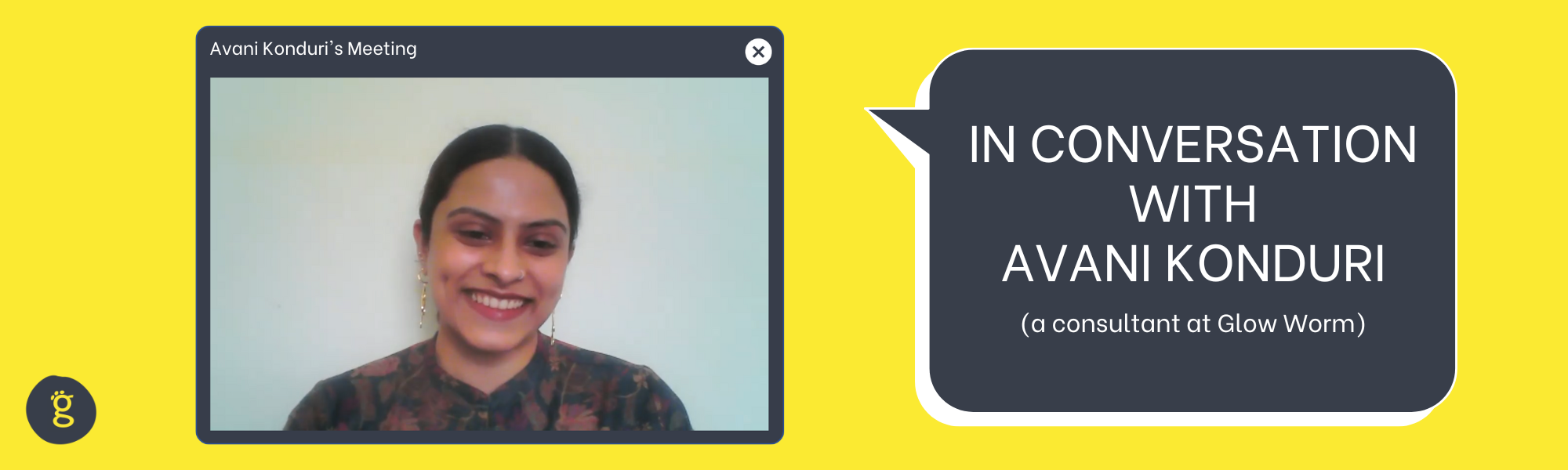
Our storyteller, Komal Srivastava, sits down with Soumya from Growth & Excellence at Glow Worm to talk about the world and work of OD.
That day, after a hearty lunch, as Soumya and I sat down together, the dip in her energy was evident. Anyone who knows Soumya, knows that a post-lunch talk is not something she particularly prefers. However, little did I know that the moment our conversation would shift towards her work at Glow Worm, her energy too would completely shift gears!
The very minute she started talking about her experiences at Glow Worm and what she finds unique about the way we approach consulting, her eyes lit up with an unmistakable spark. It was as if a switch had been flipped. This was the first time I was noticing Soumya, struggling to hold on to her list and pointers. There was so much she was eager to share that she didn’t know where to start! But when she did, it was clear that she finds fulfillment and joy in every aspect of her role, be it as a coach, consultant, facilitator, or large program manager.
As we celebrated her remarkable three years at Glow Worm, her passion for her role(s) at Glow Worm is palpable throughout our conversation. Join us in Chapter 1 of this conversation as Soumya shares insights into how she has been designing change and learning experiences for the past twelve years, why she believes organizations must leverage an OD lens, and the challenges and opportunities she encounters in the world of OD:
You have over twelve years of experience designing and shaping learning experiences for individuals and communities. Tell us a little bit about how you approach designing learning experiences that cater to diverse learning styles and preferences?
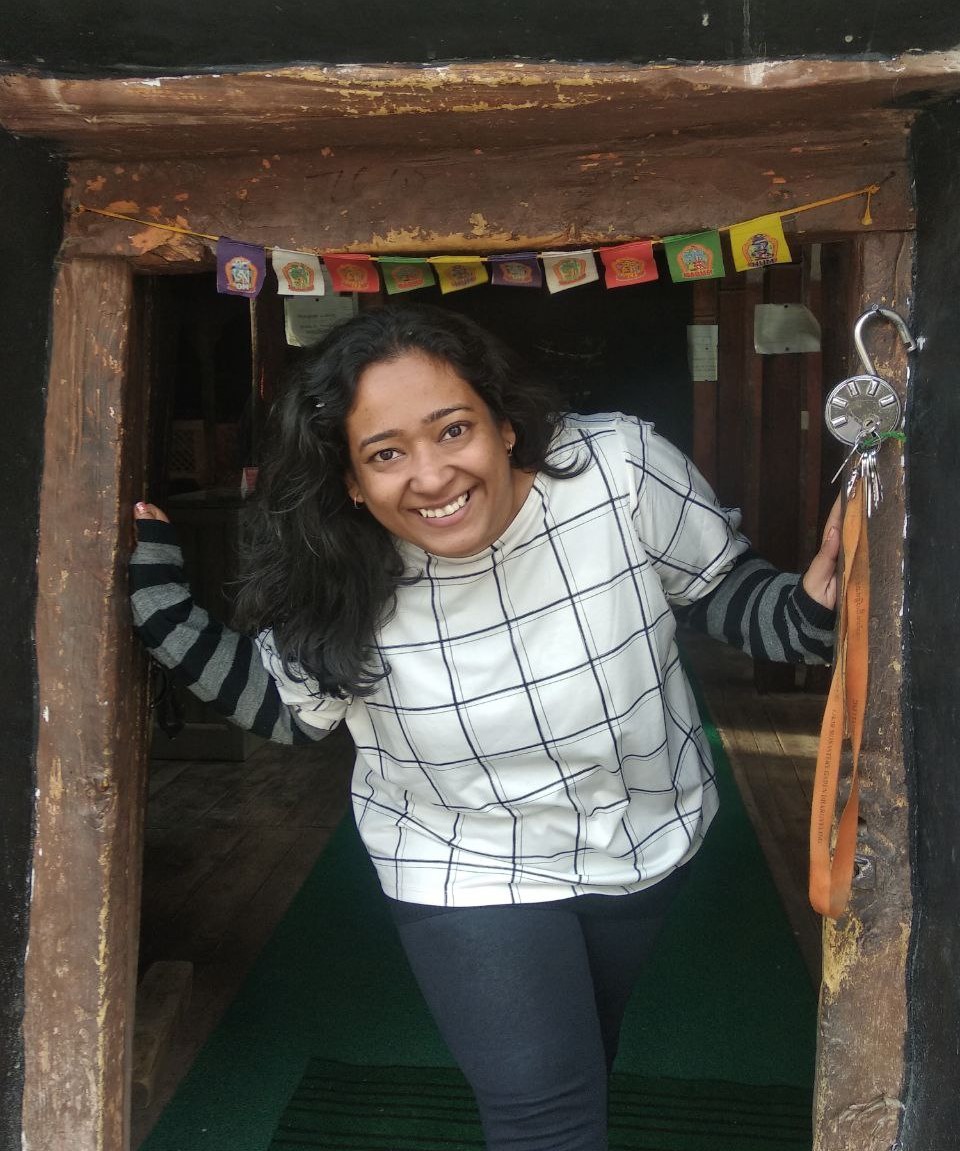
Over the years, what has been one of my biggest learnings as I moved from working with children to working with adults, has actually been something that Simon Sinek says. Which is, people really care about the why before they care about the how and what. That’s been my approach to designing learning experiences with adults
One is to clarify why are we engaging with a particular topic. And the second is also giving them a sense of direction — how are we going to do this and what are we going to do.
To cater to diverse learning styles and preferences, I often refer to the Kolb’s framework, which I’ve found is often one of the best frameworks to use when you’re thinking about how people learn and process.
The framework includes four stages: feeling, watching, thinking and doing. I try to keep that in mind and then intentionally think through having all of the different formats of learning — discussions, simulations, case studies, Q&A, and pre-/post-work activities — to engage participants effectively.
As both a facilitator and a designer, part of my role is to uncover the learning styles and preferences of the participants.
For instance, I recently facilitated a session with a seemingly quiet group. Initially, I wasn’t sure if they were learning anything. But in the second half of the session everyone was asking questions and responding. I then realized that they were probably just a more reflective group and needed that time to process. So, it’s also a lot about genuine observation and then catering all the formats of learning to that
Over the past three years at Glow Worm, you’ve donned multiple hats - coach, consultant, facilitator, program manager and more. Which one do you enjoy wearing the most, and which one did you find has caught you by surprise?
My relationship with understanding what the hat of a consultant is has really caught me by surprise. Which is very strange because that’s the role I’d applied for when I’d joined Glow Worm. I’ve gone from being excited about it to feeling uncertain and questioning if it’s even the right fit for me to also being really energized by it! What caught me off-guard the most was recognizing my own contributions and the impact I could make as a consultant.
My greatest enjoyment in the role of a consultant is the opportunity to see the bigger picture, rather than focusing on individual isolated parts. Even when I am making small contributions, I can view them as part of a larger interconnected whole. Consulting has truly empowered me with this broader perspective.
As for the roles I enjoyed the most, I’m having a really tough time choosing between program manager and facilitator. Program management gives me personal satisfaction because things get done. Things move and I can see the movement and change happening. The simple act of marking a task as “completed” on an Excel sheet always leaves me with this rush that is just unparalleled!
On the other hand, being a facilitator is exciting but demands a lot of energy. Despite the initial ups and downs, I eventually feel thrilled and fulfilled by the experience, usually a few days after the facilitation session has ended. It’s like a delayed but positive realization of – “Oh wait…that was really good!”
Facilitation also gives me the opportunity to foster connection with countless individuals. The sheer number of participants I’ve interacted with throughout the sessions over the years is difficult to keep track of!
What particularly stands out for me, something I always try to remember, is the impact you can have with people even when you are not necessarily directly engaging with them. Even in just those two-three hours of engagement there is tremendous potential for meaningful impact and learning.
In the past three years, you’ve worked with clients from diverse industries— e-commerce, renewable energy, sales and domain registry.While each might come with their own set of unique challenges, are there any common organizational development issues or opportunities that you often encounter?
When you think about it, in an organization there are a lot of moving parts. And organization development is a lot about building alignment between, let’s say, strategy, structure and people, or reward metrics and management processes. Sometimes when you’re in the execution, that alignment often goes missing.
Some of the common organizational development challenges are related to learning philosophy, organizational culture, people capacity development, building effective managers, and nurturing leadership. These are not training topics, but often training solutions are expected, when they are in fact more nuanced issues requiring holistic solutions.
For example, understanding and living the organizational culture remains a significant issue because many organizations struggle to achieve true cultural integration. What does it mean to live your culture? How does culture come into all processes? How does culture play a role in bringing an organization alive every single day?
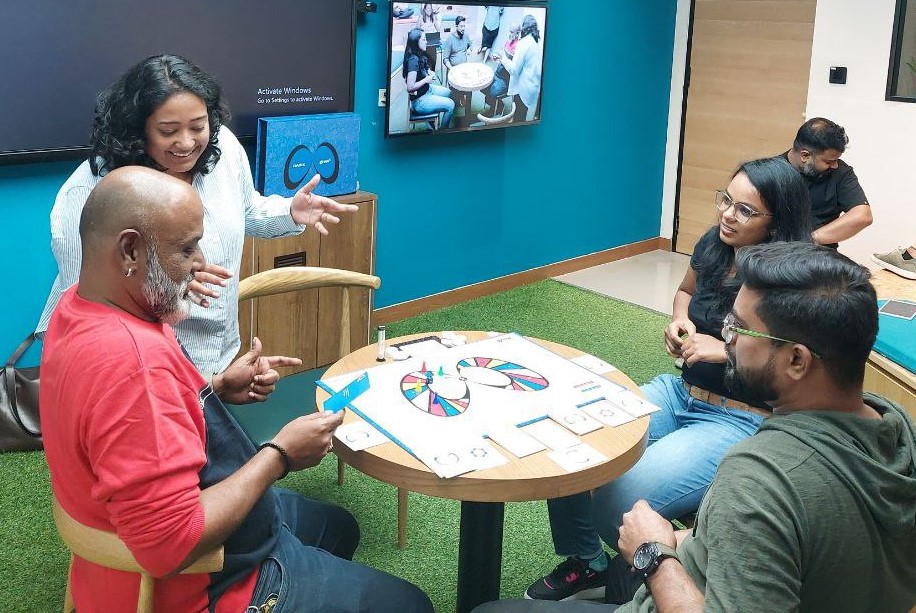
Soumya at the .Grow board game evening at Radix
Then, there are certain challenges that organizations face depending on the stage of their growth or lifecycle. For instance, in the early stages, there is a lot of initial capacity building. As a company matures, challenges around employee engagement and retention may arise. Managing transitionary and change processes also becomes crucial as an organization goes through different stages of its life cycle. Many organizations also struggle with understanding and defining what leadership means to them and how to nurture effective leaders.
It’s therefore essential to have a well-defined learning philosophy and dedicate time for both thinking and execution.
Organizations need to carefully consider and think through how they want their people to learn and what learning means to them. And this needs to be balanced with systems and environments that enable learning in practice.
Both your research and your practice are guided by your passion for creating impact, implementing sustainable solutions and enabling scale. What do you think organizations miss out on, when they do not leverage an organization development approach?
Often, the biggest and most complex problems in the world arise when attempts are made to solve one part of an issue without considering how it might impact other interconnected elements of the system. Instead of addressing problems in silos, the OD lens allows for a holistic view, enabling organizations to see the system as a whole and understand the interdependencies between various elements.
By not leveraging the OD lens, organizations also fail to recognise that they are fundamentally driven by people.
Organizations are not made up of floor plans and real estate; they’re built and created by people. When I think of the OD lens, I consider three critical elements: purpose, process, and people. When organizations neglect this perspective, they don’t realize the profound impact that the alignment of these factors can have on attrition, service quality, and overall performance. Instead, they end up getting stuck in a cycle of fixing one problem after another.
To truly understand organizations, we need to start looking at them as societies of interconnected human beings. As soon as we bring the human lens in, we’ve brought the OD lens into it.
If you enjoyed reading this, stay tuned for Chapter 2!