“Listen to your heart” — how often have you heard this or even said this to others? This timeless piece of advice has been handed down from one generation to the other with great care. It’s probably because somewhere we have always known that our feelings are like a compass. They guide us through the complexities of life, help us make sense of the world, understand ourselves better, and connect with others.
Whether it’s the joy of reuniting with an old friend over lunch, the impatience while standing in a long line, or the disappointment when your favorite ice cream flavor is sold out – feelings are ever-present, adding a distinct hue to the canvas of our day.
We are feeling creatures, experiencing a spectrum of feelings from the mundane to the profound. These feelings are our constant companions, shaping our decisions, guiding our interactions, and coloring our memories. And yet, paradoxically, we often sweep them under the rug, treat them as secondary to our thoughts, and shy away from discussing them openly.
We readily chat about the weather, share our thoughts on the latest movies, and dissect our favorite sports teams’ performances. But when it comes to our feelings, we often find ourselves lost for words, struggling to articulate what’s happening within us, or even minimizing or denying our feelings so as not to get “carried away” in them. But the reality is that our strongest memories and best decisions come when we actively embrace our emotions and invite our logic and emotions to work together!
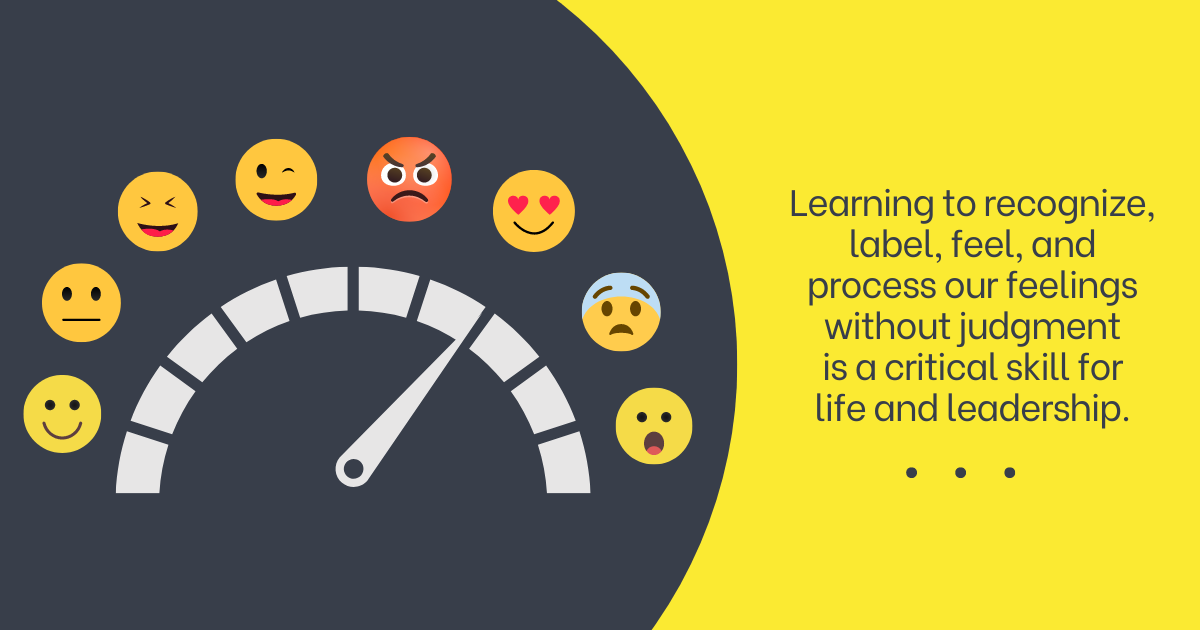
These feelings, whether simple or complex, subtle or intense, have a significant impact on our daily lives. Learning to recognize, label, feel, and process them without judgment is a critical skill for life and leadership. When we acknowledge and accept our feelings, we gain a deeper insight into ourselves and those around us. This self-awareness empowers us to make better decisions, build stronger relationships, and lead with authenticity and empathy. It enhances our personal lives and our effectiveness in our roles as leaders in an ever changing world.
As we built our own understanding of emotions and feelings, we have enjoyed learning from the greats – Paul Ekman, who identified six basic emotions aligned with unique facial expressions that accompany them; Robert Plutchik, who came up with the idea of using color to represent emotions and suggested that blending colors could represent complex emotions that emerge from the mix of multiple basic emotions; and Gloria Willcox, who came up with the idea of the concentric circles (that most of us know as a feelings wheel today), to represent primary emotions in the center and secondary and tertiary feelings on the outer circles.
Using Our Feelings Wheel
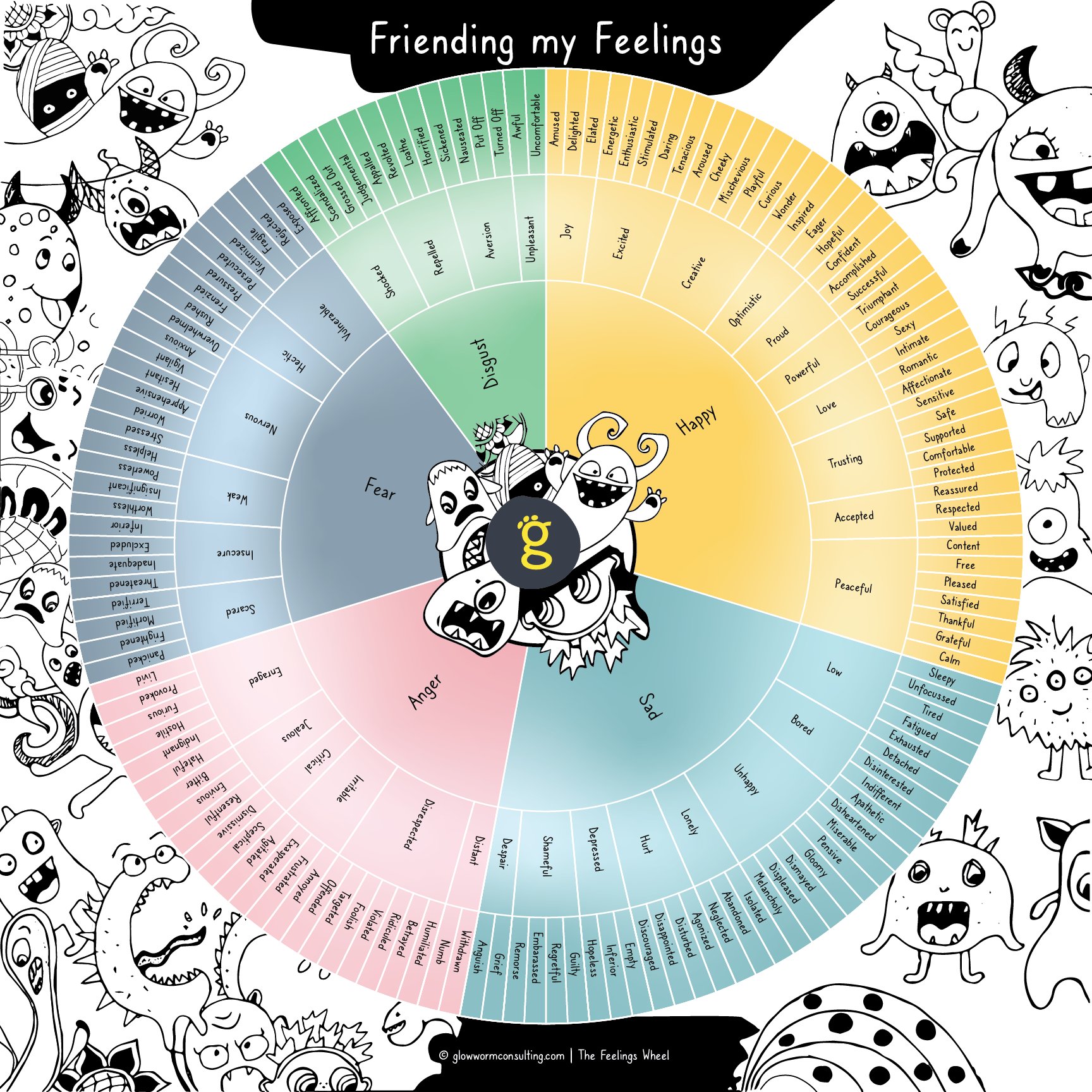
If you’re new to the feelings wheel, we want you to know that there’s no single right way to use it. You can explore it in any direction that feels right for you.
For instance, if you’re experiencing a strong emotion like anger but don’t know why, start from the inner circle (base emotions) with anger and move outward. Take a moment to consider each word in the middle circle (secondary feelings), and then proceed to the outer circle (tertiary feelings).
As you evaluate the feeling words, some questions that you could use are:
-
What makes me sure of this word to describe my feeling?
-
What makes me sure one of the other words here does not describe my feeling better?
-
Since when have I been feeling this way?
-
What is causing me to feel this way?
Similarly, you can start from the outer circle and move inward, or start in the middle and move in any direction. Remember, it’s more important to use the wheel than to worry about using it “correctly.”
Using the feelings wheel in this manner, to process your feelings will:
-
Offer you clarity and help you feel in control of your own experience than feeling out of control in your own life
-
Give you the language to explain your feelings to others
-
Provide you with insights on causal factors contributing to your feelings, that you could then choose to work with in different ways
-
Create a pattern for you over time, of which feelings and emotions you experience often and which ones you would like to invite more of, for yourself
If you are familiar with feelings wheels, you might notice that our wheel isn’t symmetrical. That’s because feelings are not orderly. They don’t follow a geometric pattern where one emotion neatly splits into two secondary feelings, and each of those in turn splits into two (or more) tertiary feelings. With our feelings wheel, we want to embrace the wide and imperfect range of our feelings and capture as many unique feelings as possible. That’s why, you’ll find different base emotions with slices of varying sizes, reflecting the diversity of our emotional experiences.
And finally, we want to acknowledge that there’s no one right feelings wheel. As humans, we can experience countless feelings, and no wheel can truly capture them all. However, we’ve worked hard to include as many as possible — our wheel is a comprehensive wheel of 177 feelings. Feel free to use it, if it resonates with you. Experiment with it and see how it works for you.
If you are feeling something that you’re struggling to articulate, we hope you find a word for it on our wheel. And, if you ever come across a feeling that isn’t described on this wheel, please reach out to us — we’d love to evolve this wheel with time and further study.
Terms Of Use
-
This wheel is free for you to use – for yourself, your family and friends. Please use it and share it as widely as you can. The more we have tools to understand our experiences and of those around us, the better our indubitably and collective wellbeing will be. Please know that this wheel is not a substitute for medical advice.
-
If you are a teacher or counselor who would like to use this wheel in your work, you can use this article or buy our poster online, through Amazon. Please always use this wheel with an acknowledgement of our copyright.
-
If you would like to have this wheel translated in your language, please write to us at feelings@glowwormconsulting.com We are committed to access and inclusion in our work and will explore how we can prioritize and serve translation requests.
-
This wheel is NOT free to use for commercial purposes. Please do not use this wheel in training or consulting without explicit written permission from us. Please do not print this wheel into posters or other physical or digital products of any kind. You can request products at store@glowworm.company