Think back to the last time you handed your car keys to a valet, shared a deeply personal secret with a new friend, or hit “Accept” on a job offer from a manager you’d only met over Zoom.
In each of those moments, you were performing a small, quiet act of magic. You were engaging in Trust.
Trust is the invisible glue of our social and professional worlds. Without it, our economy would grind to a halt, our friendships would wither, and we’d never get anything done because we’d be too busy double-checking everyone else’s work. But despite its central role in human survival, trust often feels like an intangible ‘vibe’ - something that is either mysteriously there or tragically absent.
But what if trust wasn’t a mystery? What if it was a system you could understand, build, and even repair?
In 1995, researchers Roger C. Mayer, James H. Davis, and F. David Schoorman introduced a framework that transformed how we look at human connection: The Integrative Model of Organizational Trust. Whether you’re leading a diverse team or navigating a new relationship, this model provides the secret to decoding how and why we choose to rely on others.
Defining the Leap: Trust as Vulnerability
Before we dive into the mechanics, we need to clear up a common misconception. Most people erroneously think trust is the same thing as cooperation. If you do what your boss says because you’re afraid of being fired, that’s cooperation. If you sign a 50-page legal contract that penalizes the other person for every mistake, that’s risk management.
Trust is neither of these things. It is defined in the Integrative Model as: “The willingness of a party to be vulnerable to the actions of another party based on the expectation that the other will perform a particular action… irrespective of the ability to monitor or control that other party.”
To simply put, trust is choosing to be vulnerable. It’s the leap of faith you take when you can’t see what the other person is doing behind your back. It is more than mere ability to predict what they will do and if it will be beneficial to you or not. If you are monitoring someone every second, you aren’t trusting them; you’re just supervising them. But when you, for example, sign-up for a trek, put your GPS away and ‘trust’ a local guide following them up a tricky path, you’re choosing to give up control. This willingness to take a risk is the heartbeat of any trusting relationship.
Your Default Internal Trust Setting
In any trust interaction, there are two parties: the Trustor (the one doing the trusting) and the Trustee (the one being trusted). And before we even look at the other person, we have to look at ourselves in the mirror.
The model outlines a concept called Propensity to Trust. It refers to our general willingness to trust others before we have any information about them. This setting isn’t random. It is deeply influenced by our very own:
- Past Experiences: Have we been burned by a previous employer or partner?
- Developmental History: How trust was modeled for you by caregivers during your childhood?
- Cultural Context: Do we belong to a high-trust culture where a person’s word is their bond, or a culture where skepticism is a necessary survival mechanism?
If your propensity to trust is low, you might struggle to trust even the most trustworthy people. Knowing your baseline helps you realize when you are being too hard on a new person simply because of the ghosts of your past.
The Three Pillars of Trustworthiness
Once we understand our own baseline, how do we evaluate the other person? This model suggests that we judge trustworthiness based on three distinct pillars. If one is missing, the leap of faith becomes significantly harder.
I. Ability
Ability is that group of skills, competencies, and characteristics that allow a person to have influence within a specific domain. It isn’t just about being smart but about having the functional capacity to deliver on a promise.
Trust in someone’s ability is highly domain-specific. You might trust your lead developer to write flawless, secure code, but you wouldn’t necessarily trust them to lead a sensitive client negotiation. A person can have massive ability in one area and zero in another. When we trust someone’s ability, we are saying, “I believe you are capable of doing this specific job.”
II. Integrity
Integrity is your perception that the other person sticks to a set of values or rules that you find acceptable. This includes both the consistency of the person’s past actions and the extent to which their communications are truthful. It’s about the alignment between what they say and what they do.
Imagine you share a sensitive concern with a colleague in private, and they promise to keep it between you. If you later hear that same concern mentioned in a team meeting by someone else, your perception of their integrity vanishes. It doesn’t matter how brilliant they are, you now know their word carries no weight.
In the early stages of a relationship, you usually look for integrity first. Before you can know if someone genuinely cares about you (Benevolence), you look for consistency and honesty. Without this foundation, a person’s Ability can actually feel like a threat- you’ll be too worried they’ll use that ability to mislead or harm you. Integrity is also not just about being a ‘good person’; it’s about having a code that the Trustor agrees with. If a pirate is consistently a pirate, they have integrity to their fellow pirates, but not to you.
III. Benevolence
Benevolence is the extent to which a trustee is believed to want to do good to you, aside from an egocentric profit motive. It suggests a personal attachment or a genuine concern for your well-being.
Think of the difference between a manager who helps you because your success makes them look good to the leadership , and a mentor who helps you because they genuinely want you to grow as a leader, even if it means you eventually leave their team for a better role. Benevolence is the glue of long-term relationships. While Ability and Integrity can be assessed relatively quickly, Benevolence usually takes the longest to verify. It is the factor that allows trust to survive even when a mistake (a lapse in Ability) occurs.
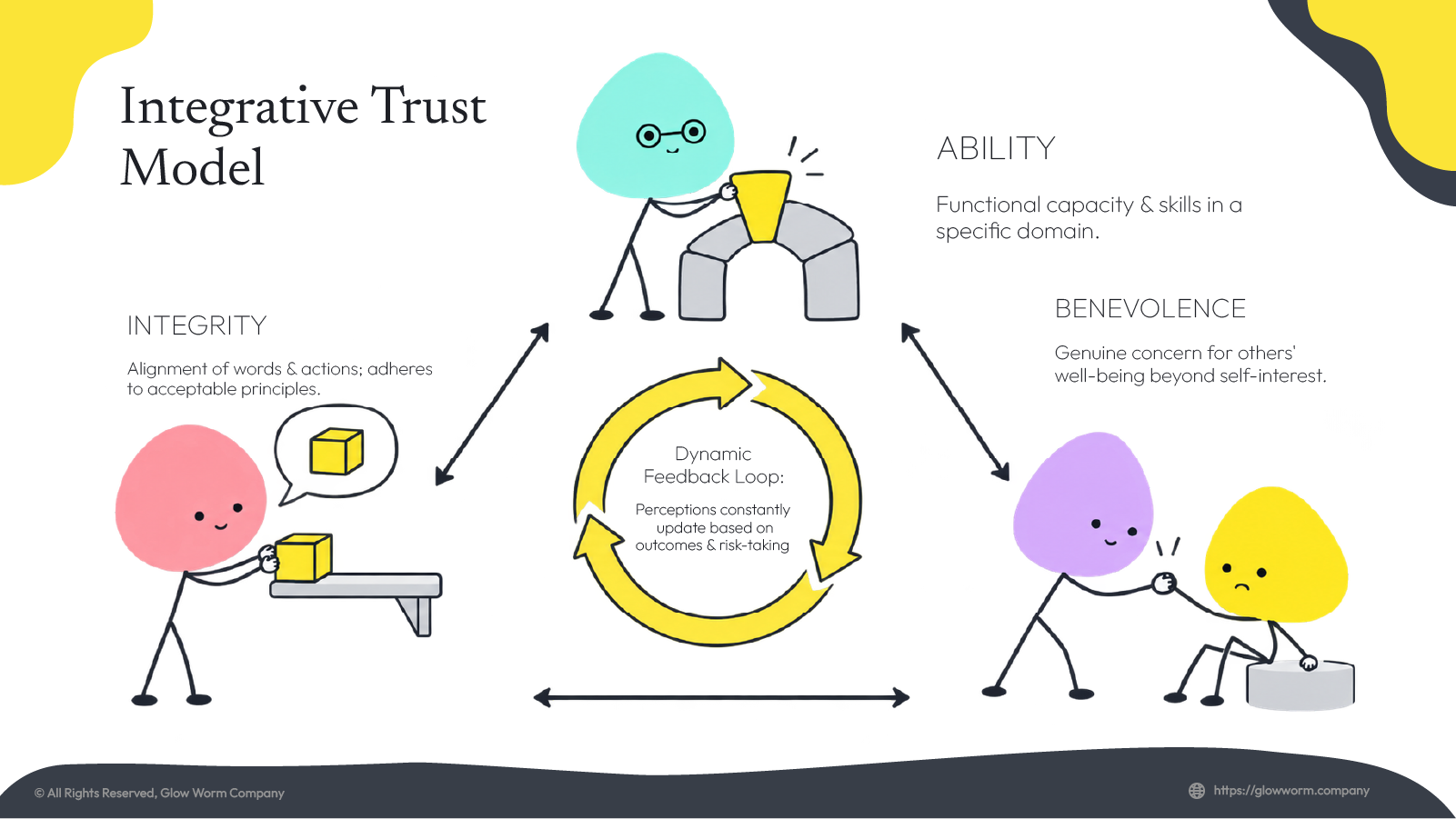
These three pillars interact in a constant feedback loop. You evaluate someone’s trustworthiness, you run it through your own propensity, and you decide to take a risk. If the outcome is positive, your trust grows. If it’s negative, the trust is damaged.
This is where the Trust Tax comes in. In low-trust environments—where Ability, Integrity, or Benevolence are lacking—everything becomes ‘expensive’. It’s the extra time and energy you spend on redundant meetings to “check in”, lengthy legal documents for simple agreements, micromonitoring and putting everything on email so that you don’t experience any blowbacks. Conversely, in high-trust environments, you get a Trust Dividend. Things move faster because you don’t have to verify every claim. It grants people more autonomy to do their best work without being micromanaged, and it creates a general greater ease of getting things done, as collaboration replaces friction.
The Challenge of Diversity: Trusting Across Difference
This model becomes especially important when we work or live with people who are different from us. Research shows that humans have a natural ‘homophily’ bias—we find it easier to trust people who look, talk, and think like we do.
When we encounter someone from a different cultural background, generation, or perspective, our propensity to trust often drops. We might struggle to see their Ability because they solve problems differently, or doubt their Integrity because their communication style is unfamiliar.
In diverse environments, building trust requires a more deliberate effort. We have to move past ‘gut feelings’ (which are often hidden biases) and look for objective evidence of Ability, Integrity, and Benevolence. When we bridge these gaps, the trust we build is often more resilient and leads to much stronger collaboration.
The Power Dynamic: Trusting ‘Up’ vs ‘Down’
While the model provides a universal blueprint, the original research acknowledges a critical reality: Power affects the stakes of the leap. Whether in the office or our personal lives, the risk of being vulnerable is rarely equal for both parties.
- Trusting Down (Higher Power to Lower Power): When you hold more power—whether as a senior leader, a long-standing member of a social group, or even the more financially stable partner in a relationship—the risk you take in trusting someone ‘below’ you is often performance-based. If the other person fails, you might lose time, money, or a bit of your reputation. It’s an inconvenience or a setback, but it’s rarely an existential threat to your well-being.
- Trusting Up (Lower Power to Higher Power): When you are in the lower-power position, the stakes of being vulnerable are exponentially higher. This applies to a junior employee trusting a CEO, a newcomer trying to join an established social circle, or a person from a marginalized group trusting someone from a dominant one. There is an inherent lack of psychological safety. If the person with more power is not trustworthy, the less-powerful party faces the loss of their career progression, their sense of belonging, or their emotional security.
Because of this imbalance, the person with more power carries a heavier burden of proof to demonstrate Benevolence. If you have the upper hand in a situation, you cannot expect people to simply leap toward you. They are naturally, and often rightfully, skeptical of your motives.You need to proactively and consistently show that you genuinely have their best interests at heart.
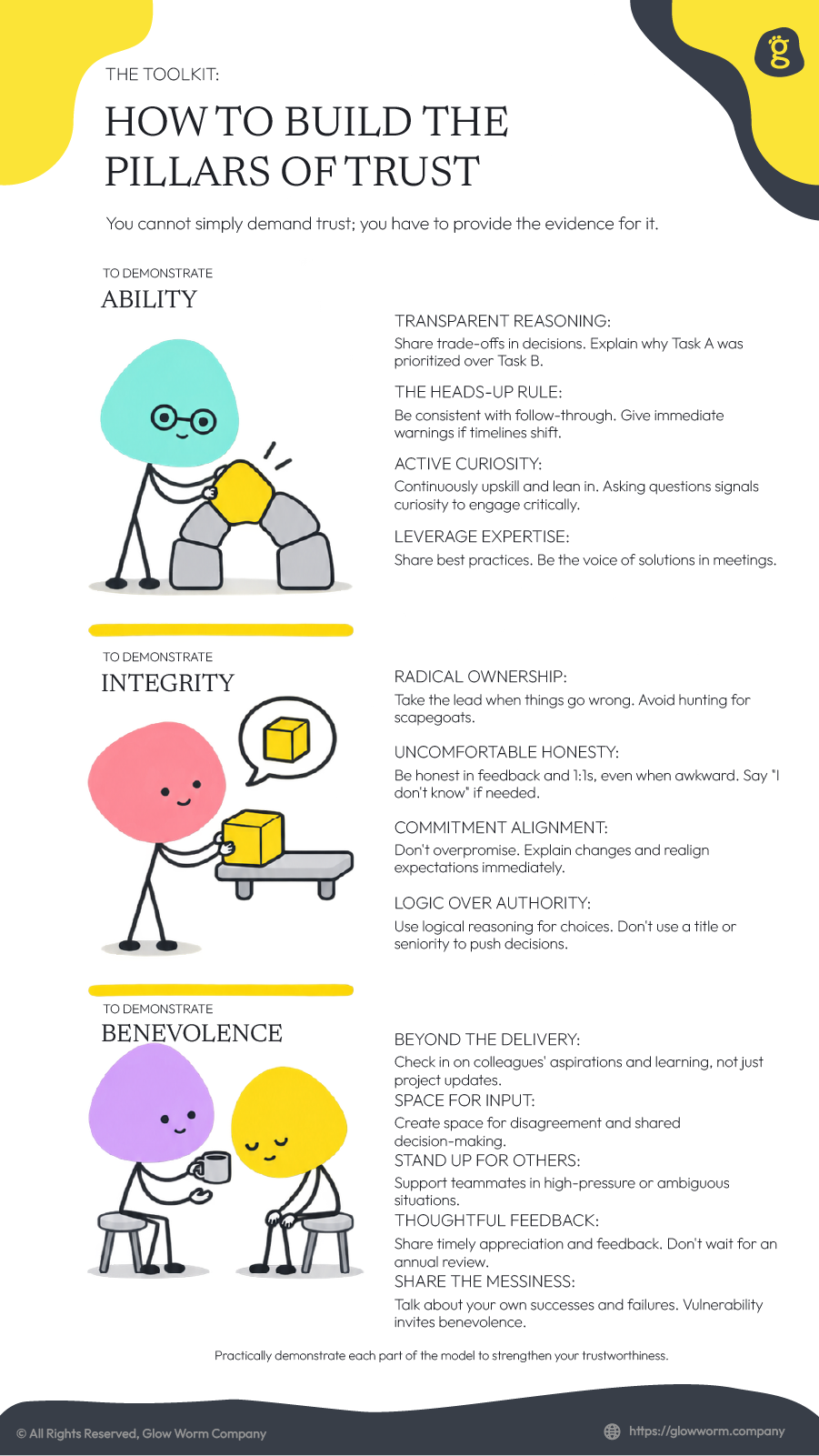
The Toolkit: How to Build the Pillars
You cannot simply demand trust; you have to provide the evidence for it. Here is how you can practically demonstrate each part of the model to strengthen your trustworthiness.
To Demonstrate Ability:
- Transparent Reasoning: Share your trade-offs when making decisions. Explain why you chose to prioritize Task A over Task B.
- The Heads-Up Rule: Be consistent with follow-through. If a timeline shifts, give people a warning immediately so they aren’t left in the dark.
- Active Curiosity: Continuously upskill and lean in during huddles or critical decisions. Unlike popular belief, asking questions actually signals curiosity and competence to critically engage with topics.
- Leverage Expertise: Share best practices and be the voice of solutions in meetings.
To Demonstrate Integrity:
- Radical Ownership: Take the lead when something goes wrong. Avoid hunting for scapegoats.
- Uncomfortable Honesty: Be honest during feedback and 1:1s, even when it’s awkward. If you don’t know the answer, say “I don’t know.”
- Commitment Alignment: Don’t overpromise. If things change, explain why and realign expectations immediately.
- Logic over Authority: Use logical reasoning to explain your choices. Don’t rely on your title or seniority to push a decision through.
To Demonstrate Benevolence:
- Beyond the Delivery: Check in on colleagues beyond project updates. Get to know their aspirations and check in on their learning.
- Space for Input: Create space for disagreement and shared decision-making.
- Stand Up for Others: Support teammates in high-pressure or ambiguous situations.
- Thoughtful Feedback: Share timely appreciation and feedback. Don’t wait for an annual review.
- Share the Messiness: Talk about your own successes and failures. Your vulnerability invites benevolence from others.
The Courage to be Vulnerable
The Integrative Trust Model takes trust out of the realm of ‘vibes’ and puts it into the realm of deliberate practice.
By focusing on Ability, Integrity, and Benevolence, you gain a roadmap for your relationships. You realize that your own ‘Propensity to Trust’ is a lens you can clean and adjust based on your past and your culture.
Trusting someone is an act of courage. It is an invitation for someone else to potentially let you down. But as this model shows, it is also the only way to build anything of lasting value. When we understand the pillars, the leap of faith doesn’t feel so scary—because we finally know what we’re looking for in the person waiting to catch us.