Have you ever felt stuck in a loop? Maybe it’s that New Year’s resolution to “get fit” that collapses by February, a recurring argument with a loved one, or a project at work that keeps hitting the same roadblocks. You tweak your approach, try a new tactic, and yet, you end up right back where you started.
It’s frustrating, right? The problem often isn’t your effort; it’s the level at which you’re trying to learn and adapt. Most of us are masters of what’s called single loop learning. It’s useful, but it has its limits. To create real, lasting change, we need to go deeper.
Welcome to the powerful world of triple loop learning! It’s a framework that sounds academic but, at its heart, is a profoundly human way to unlock growth, innovation, and purpose. It’s not just about fixing mistakes or questioning your strategies, but questioning your assumptions about why you do what you do at all. It’s the study of our underlying values, the why beneath the how and the what.
Triple Loop Learning can be applied anywhere- in families, workplaces, teams, classrooms, even personal growth journeys. Because at its core, triple loop learning is an act of metacognition- thinking about your thinking. It’s the ability to step outside yourself and observe the mental and emotional architecture that dictates your reality.
The Origins of Deeper Learning
The concept of learning loops emerged from decades of research into how we and the systems we create learn. The story begins with Chris Argyris and Donald Schön, organizational theorists who, in the 1970s, introduced the ideas of single and double loop learning. They noticed that brilliant professionals were often terrible at learning because their egos and defensive routines prevented them from questioning their own assumptions (called a ‘double loop failure’). While Argyris and Schön do not themselves use the term ‘Triple Loop Learning’, later organisational psychologists built on these ideas to establish the three loops of learning as we know them now.
Recent thinkers like Peter Senge in* The Fifth Discipline* who popularized the idea of systems thinking and Jack Mezirow’s theory of transformative learning have bolstered the research around Triple Loop Learning.
Let’s try and break down these loops of learning to understand them better.
The Three Loops: From Minor Tweaks to Major Transformation
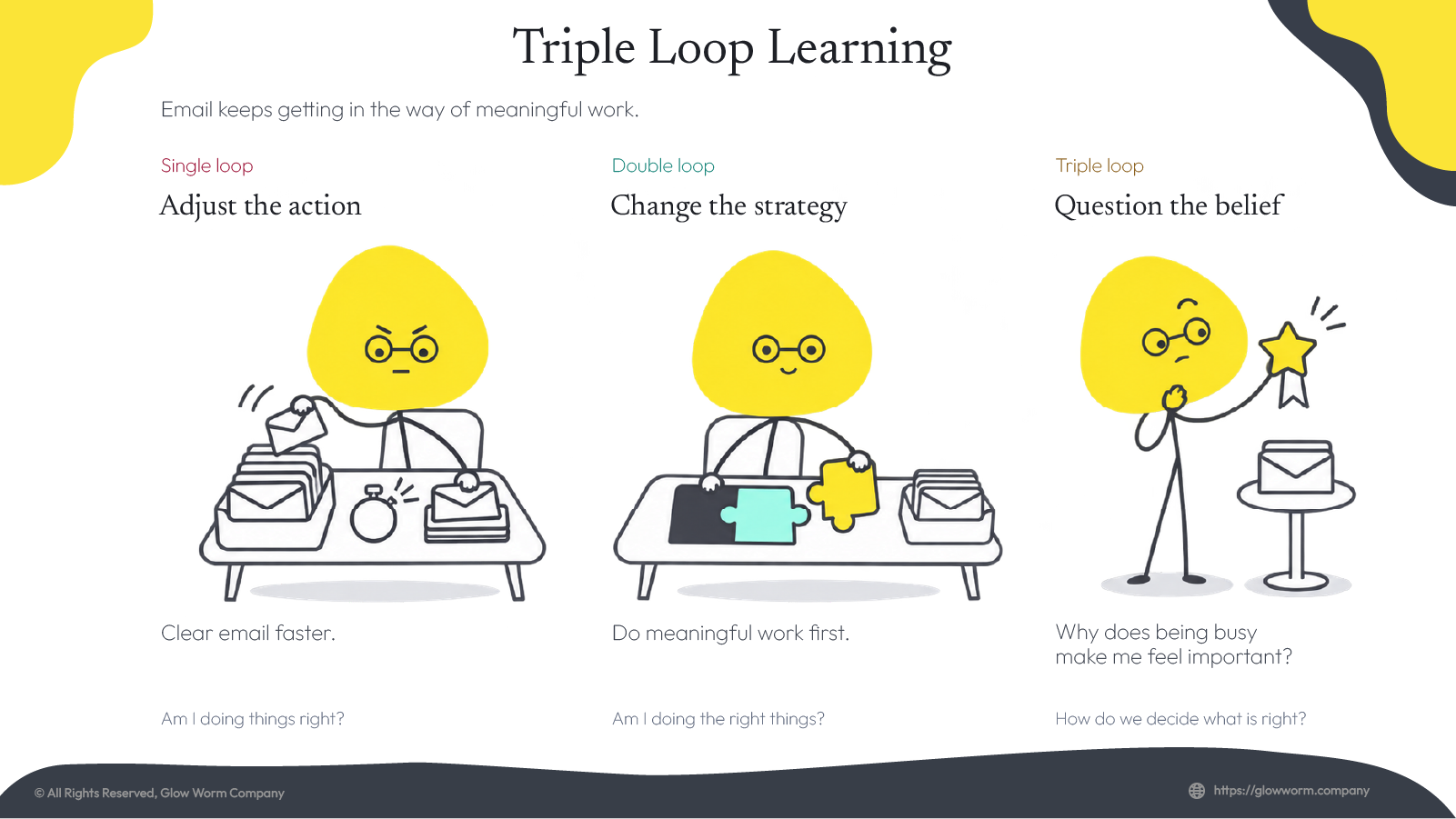
- Single Loop Learning: “Am I doing things right?” This is the most common form, where we detect and correct errors to improve our actions without questioning our underlying beliefs. For example, if your pasta sauce tastes bland, you simply add more salt to fix it according to the existing recipe.
- Double Loop Learning: “Am I doing the right things?” This is where we go deeper by questioning the governing variables themselves, such as our strategies and goals. For example, instead of just adjusting the salt, you might ask, “Is this recipe the right one?” and decide to use fresh tomatoes instead of canned ones.
- Triple Loop Learning: “How do we decide what is right?” This is the deepest level, involving a transformation of our entire framework for understanding where we question our underlying values and belief system that inform our strategies and goals. For example, this could mean questioning why you feel the pressure to get the recipe right or are chasing that nostalgic taste of the sauce you remember instead of simply enjoying a decent home cooked meal?
Most of us are great at the first loop, but real breakthroughs happen in the second and third loops.
In Boardrooms and In Daily Life
Researchers have found that organizations that make space for triple loop learning are more likely to spot early warnings of crisis, attract creative talent, and even outperform their peers over time- because they adapt at a deeper level than just tactics or processes.
Companies stuck in a single loop often respond to declining profits by cutting costs or pushing their sales teams harder; doing more of the same, just faster. A double-loop organization pauses to ask, “Is our product still relevant? Have our customers’ needs changed?” That reflection can spark innovation or new product lines. But a triple-loop organization goes deeper; it asks fundamental questions about its very purpose and identity. Let’s look at a case study to see what that looks like in action:
For decades, Blockbuster was the king of movie rentals. When faced with declining sales, their response was pure single-loop: rearrange the stores, change the late fee policy, and run more ads.
Netflix, on the other hand, challenged Blockbuster because they started with a double-loop question of Are we doing the Right Things?: “Is the physical store the right model for renting movies?” This led to their subscription-driven DVD-by-mail service.
But their ultimate success came from a triple-loop transformation. After Netflix failed to be acquired by Blockbuster for a mere $50 million, they asked a fundamental identity question of Is this the Right Thing to do?: “Are we in the business of renting DVDs, or are we in the business of delivering entertainment?” This shift in identity allowed them to pivot to digital streaming and then to producing original content, becoming the powerhouse that they are today. They didn’t just change the rules; they created a whole new game.
Triple Loop Learning isn’t just for businesses. On a personal level, triple loop learning can spark big changes- sometimes positive, sometimes unsettling.
- Self-awareness grows: You start to notice why you habitually react to challenges or make certain decisions. This depth of reflection can lead to life-changing choices or renewed commitment.
- Empowerment & confidence: When you understand the values driving your behaviors, you’re less likely to act out of habit or obligation, and more likely to make intentional choices.
- Productivity boost: You can prune routines that don’t serve your real goals and focus on ones that do.
For example, you spend hours clearing emails each morning before starting meaningful work. At first you try new productivity tools (single loop). Then you reconsider whether checking email first thing actually helps your priorities (double loop). The triple loop comes when you ask: Why do I equate busy-ness with importance? What belief about control or responsiveness sits underneath this habit?
Equipping Your Reflective Toolkit
Following a “plan, do, review” framework in itself is not revolutionary and is arguably one of the most important human traits of all. The learning loops model makes us dig deeper to understand the level at which we are reviewing things.
- Identify the loop: When addressing a problem or challenge, start by naming the loop you are in.
- Single Loop: Are we adjusting actions or strategies to fix mistakes?
- Double Loop: Are we questioning if our goals or rules themselves need changing?
- Triple Loop: Are we reflecting on the values, mental models, or organizational context driving those goals and actions?
- Reflect on assumptions and values: Some good starting questions to ask yourself to understand where your approach stems from are:
- Why do I (or my organization) prioritize this goal?
- What beliefs guide the way we approach problems?
- How might our culture or norms shape our choices?
- Who benefits or loses from these assumptions?
- Involve others for broader perspectives: Single and double loop learning can happen individually, but triple loop learning often requires collective reflection. Team discussions, feedback sessions, or facilitated workshops can help uncover blind spots and challenge power relations that reinforce the status quo.
-
Experiment with new ways of thinking and acting: Triple loop learning is not just reflective—it’s generative. Try new mental models, leadership styles, or ways to organize work. Make space for trial, error, and iteration.
-
Make space for vulnerability: Triple loop learning means being ready to look at cherished beliefs and habits. Practice curiosity—don’t judge yourself or others. Reflection journals, buddy systems, or facilitated group conversations can encourage this process.
-
Institutionalize it: Individuals and organizations that thrive embed triple loop learning into their routines:
- Personal: Set aside a few minutes each week to reflect using the loops
- Teams: Bring triple loop questions to project debriefs, staff meetings, or planning sessions. Allow time for collective sensemaking, not just action-items.
- Organizations: Build learning reviews into your processes. Encourage “what’s behind this norm?” discussions, especially on persistent challenges.
It’s not a fix-all Silver Bullet
Triple loop learning is powerful—but it’s not always comfortable or quick.
- Not every problem needs a revolution: Sometimes, quick fixes are what you need. Not every situation demands or can handle the deep work of a triple loop review. The skill is knowing when a problem is a symptom of a deeper issue.
- It can feel destabilizing: Questioning your core beliefs or your company’s mission is tough, uncomfortable work. It takes time and trust to engage with loops of learning. Teams and relationships must feel safe for this kind of inquiry. Without that, efforts may stall or even backfire
- Beware of analysis paralysis: The goal of deep reflection is to inspire better, wiser action- not to get stuck in endless philosophical debates. If you get stuck forever analyzing “why” without considering the “what” or “how” you risk never moving to action. The loops are meant to complement, not replace, each other.
- The model is nonlinear in practice: It’s a mistake to see triple-loop learning as a neat, linear ladder you climb from one to three. The process is often messy, iterative, and unpredictable. A profound, triple-loop “aha!” moment- a sudden shift in identity or purpose- can emerge unexpectedly, forcing a complete re-evaluation of your strategies (double-loop) and daily actions (single-loop) in its wake. Conversely, the persistent failure of a simple, single-loop fix can be the very catalyst that eventually forces you to confront the deeper questions of identity and values. The loops are in a constant, dynamic dance, not a rigid sequence.
Break Free Using Triple Loop Learning
Triple Loop Learning invites us to look deeper than just quick fixes or incremental tweaks. Instead of just solving the problem in front of us, it asks us to reimagine the framework we used to define the problem in the first place.
Whether you are trying to get unstuck personally, transform a relationship, or improve team dynamics, this approach equips you to ask better questions. It suggests that real learning isn’t just about what we do (actions) or why we do it (strategy)—it’s about examining the context—the underlying stories and values—that shape our reality. By getting curious about our deepest assumptions and daring to reframe them, we move beyond temporary solutions toward sustainable, authentic growth.