Have you ever been in a conversation where you could just tell the other person wasn’t really with you? Maybe their eyes were darting around, or they were quick to jump in with their own story before you’d even finished your sentence. You walk away feeling a little empty, a little unheard.
We’ve all been on both sides of that exchange. In a world that feels increasingly disconnected, this experience is frustratingly common. It’s easy to think of listening as a passive activity that just happens while we wait for our turn to speak.
But what if listening wasn’t just waiting to speak, but a powerful, active skill that could fundamentally change the quality of our relationships? What if this one skill could help you create safer, more innovative teams as a leader? Or raise children who feel truly seen and understood by us as a parent? Or build friendships that last a lifetime?
This is the promise of deep, intentional listening. The Co-Active Training Institute’s “3 Levels of Listening” provides a simple map to do just that. It’s a framework that can guide us from noisy, distracted conversations to moments of genuine connection and insight.
We explore this transformative framework: first, by understanding its foundations and the three levels themselves, and then by offering a practical path to start using them.
The Origin of Formal Listening
The framing of listening as a skill began in the 1940s with psychologist Carl Rogers. He discovered that empathetic listening wasn’t just a nice thing to do but a powerful therapeutic force. A safe, non-judgmental space, he found, allowed speakers to engage in deeper self-discovery.
Building on this, Rogers and Richard Farson coined “Active Listening” in 1957, noting that people who are truly heard become better at listening to themselves. In the 1960s, Thomas Gordon, a follower of Rogers, expanded this idea beyond therapy into everyday life, identifying common communication roadblocks.
As coaching became widespread, the Co-Active Training Institute built on these foundations. They synthesized this work with their own observations to create the 3 Levels of Listening—a simple, teachable framework for a deeper listening experience.
The Three Levels of Listening
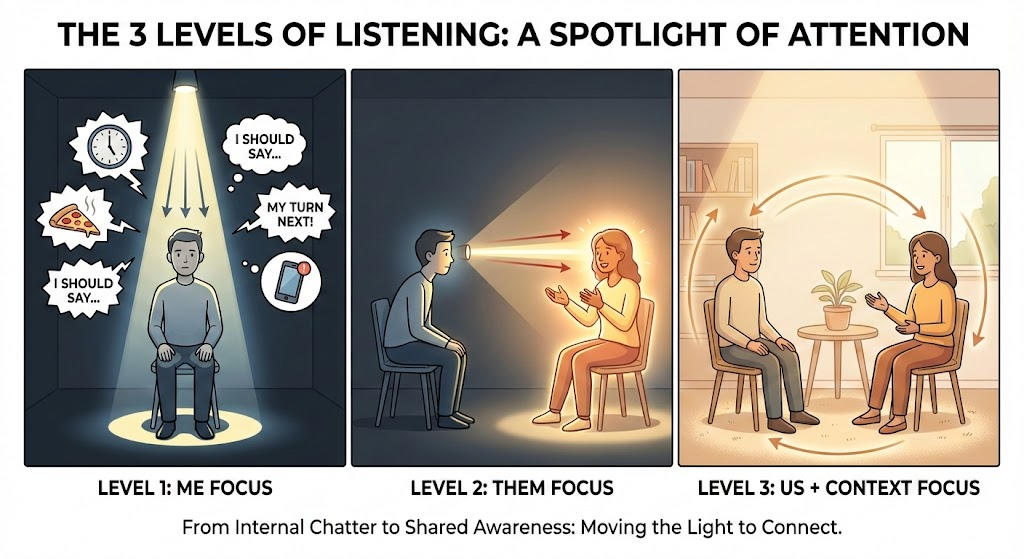
The Co-Active model has three levels. No level is ‘bad/ insignificant’ but each has a purpose. The real breakthrough is learning to recognize which level we’re in and choose the one that best serves the moment. The framework describes three modes of attention, moving from self-focus to expansive, relational awareness.
Level 1: Internal Listening
“What does this mean to me?”
Level 1 is our default setting, where our awareness is pointed inward. We listen, but we filter everything through our own thoughts, feelings, and experiences. Our internal narrator runs a constant commentary.
Imagine a friend shares their frustrating day. In Level 1, your mind is busy.
- What it looks like: You’re nodding, but planning your response or searching for your own similar story.
- What it sounds like in your head:
- “Oh, that reminds me of what happened to me!”
- “I totally disagree with that.”
- “What’s for dinner tonight?”
- “I have the perfect advice for them.”
Level 1 is necessary for self-awareness. If someone asks, “Pizza or pasta?” you need Level 1 to answer. It becomes a problem only when we get stuck there while trying to connect with someone else.
Level 2: Focused Listening
“What does this mean to them?”
Level 2 is a conscious shift of focus entirely onto the other person.
We turn down our internal narrator and tune in completely to their words, tone, and emotions, becoming intensely curious about their world.
It might be helpful to think of it as a laser beam of attention, directed at understanding their experience from their perspective.
- What it looks like: You make eye contact and lean in. You notice their body language and the energy behind their words, without planning your own story or advice.
- What it sounds like coming from you:
- “Tell me more about that.”
- “What was that like for you?”
- “I’m hearing that you felt undervalued. Is that right?”
- (Silence, holding space for them to continue.)
At Level 2, people feel seen and heard. You aren’t fixing or judging - you are simply present, offering undivided attention. It’s a powerful gift that builds trust.
Level 3: Global Listening
“What are we noticing together?”
Level 3 is the most expansive listening. It includes Level 2’s sharp focus while adding a wider, softer awareness of the entire environment. You listen not just to the words, but to the space between them.
At level 3, you tune into the room’s energy, unspoken feelings, intuition, and the context. It’s like zooming out a camera lens: the person is still clear, but now you see everything around them.
- What it looks like: Noticing a subtle shift in mood. Sensing an unspoken idea. Connecting what’s said to a larger pattern.
- What it sounds like coming from you:
- “I notice the energy drops when we mention the deadline. What’s that about?”
- “Is there an unspoken question here we should name?”
- “I’m sensing a real excitement under the surface as you talk about this project. Is this something you’d like to work on.”
Level 3 listening allows for true collaboration and “out of the box” insights, helping groups uncover underlying issues and find creative solutions.
What Does the Research Say?
There is abundant evidence which shares the importance of the deep listening process.
A 2020 Salesforce study, for instance, found that employees who feel heard are 4.6 times more likely to feel empowered to do their best work.
Neuroscience confirms what great listeners have always sensed: being genuinely listened to is a biological intervention. When a person feels truly heard, their nervous system shifts from a defensive “away” state (fear, self-protection) to an open, creative “towards” state (curiosity, possibility). In this receptive state, the brain can physically rewire itself. Researcher Daniel Siegel calls this “integration”, the collaboration between logical and intuitive hemispheres that supports creativity and growth.
Research also highlights the high-stakes importance of Level 3 listening. In Fearless Organizations, Amy Edmondson and in Humble Inquiry, Edgar Schein argue that catastrophes like the NASA shuttle disaster were avoidable if leaders had been attuned to unspoken concerns.
Similarly, MIT studies on “collective intelligence” find the most successful teams aren’t those with the highest IQs, but those whose members are “socially sensitive”, meaning, they are skilled at picking up nonverbal cues.
Listening isn’t passive. The focused empathy of Level 2 and the broad awareness of Level 3 are potent forces that build relationships, create safety, and unlock new possibilities.
Navigating the Journey: Common Hurdles
As you practice these levels, it’s helpful to know some challenges are normal. Meeting them requires courage and self-compassion.
- Shifting from Expert to Partner: Deep listening means setting aside your agenda to empower the other person. For those used to being the expert, this can feel like losing control. It’s a brave shift from having all the answers to discovering them together.
- The Courage to Be Vulnerable: Listening at Level 3 means sharing a hunch or observation. This can feel risky - What if you’re wrong? But this vulnerability is often what builds trust.
- The Myth of Inefficiency: In a fast-paced world, slowing down to listen can feel unproductive. Yet this pause is where better ideas and stronger teams are born. It’s an investment that pays off.
- The Energy of Presence: Staying focused requires managing our inner chatter.
This takes practice and can be tiring, but like any muscle, your ability to stay present gets stronger with use.
A Practical Pathway to Deeper Listening
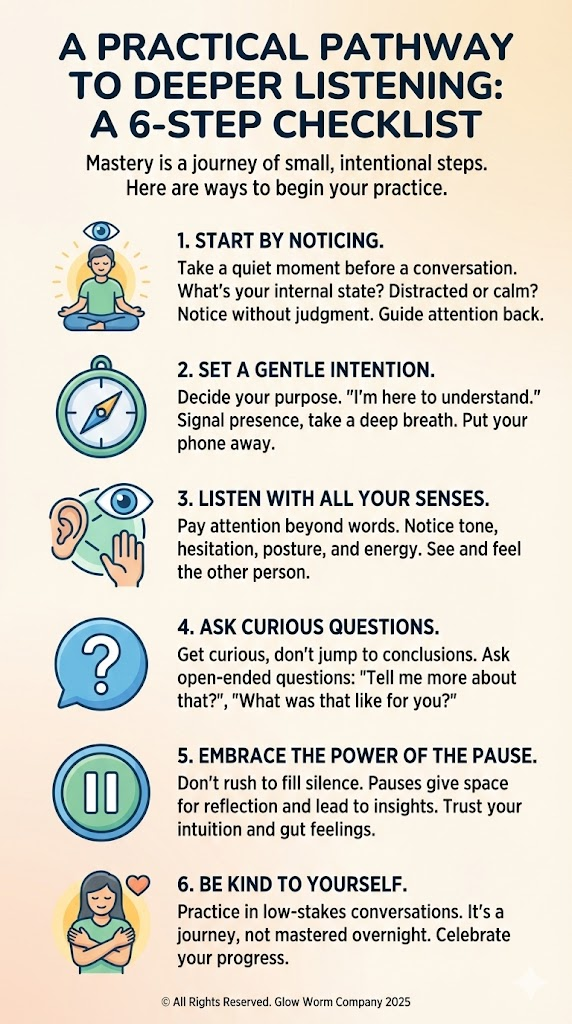
Mastery is a journey of small, intentional steps. Here are ways to begin your practice in all parts of your life.
1.Start by Noticing: Before an important conversation, whether it’s a big work meeting or a sensitive family discussion, take a quiet moment. What’s your internal state? Distracted or calm? Noticing your state without judgment is the first step. If you drift to Level 1, gently guide your attention back.
2. Set a Gentle Intention: For important conversations, be it a performance review or a heart-to-heart with a friend, decide your purpose. A simple thought like, “I’m here to understand,” can shift your entire approach. Put your phone away. Take a deep breath. Signal that you are truly present.
3. Listen with All Your Senses: Pay attention to more than words. For example, in a negotiation conversation, notice the hesitation in their tone or if with your child, notice the slump in their shoulders. This is how one can move to Level 2, where the other person feels truly seen.
4. Ask Curious Questions: Get curious instead of jumping to conclusions—this works for both professional and personal relationships. Ask open-ended questions like these to unlock deeper understanding:
- "What was that experience like for you?"
- "Can you tell me more about that?"
- "What's most important about this for you?"
Taking a humble inquiry approach when questioning could help the other person put their guards down and approach the conversation more authentically.
5. Embrace the Power of the Pause: Don’t rush to fill silence. This is a powerful tool in a tense team meeting and in a difficult personal talk. Pauses give the speaker space to reflect and often lead to new insights. Also, trust your intuition. Sometimes, those gut feelings are your system picking up unspoken cues.
6. Be Kind to Yourself: You won’t master this overnight. Start by practicing Level 2 in low-stakes conversations, maybe with someone at a cafe or a colleague in the breakroom. As you get comfortable, you’ll find opportunities for Level 3 in more important moments. Do not forget to celebrate your progress.
The Gift of Listening
In a disconnected world, choosing to truly listen is a powerful act. This framework is a map from the self-focus of Level 1, to the deep connection of Level 2, and the shared wisdom of Level 3.
A leader who listens this way creates safer, more innovative teams. A parent who listens this way raises children who feel seen and understood. A friend who listens this way builds relationships that last.
The journey begins with one conversation. Today, try choosing Level 2. Set aside your agenda, quiet your inner voice, and listen simply to understand. Notice what changes when the other person feels your full, supportive presence. That is where the transformation begins.