Have you ever found yourself screaming at a television screen, shouting, “We won!” after a football game, despite the fact that your only contribution to the victory was eating a frightening amount of chips on your couch?
Or perhaps you’ve walked into a cafe and felt an immediate, unexplained solidarity with a stranger across the room wearing a sweatshirt from your alma mater?
If you sheepishly nodded yes at either of these, congratulations: You have just experienced the invisible but powerful manifestation of Social Identity Theory!
For decades, psychologists have been fascinated by our desperate, primal need to belong. Social Identity Theory is the psychological framework that explains how people define themselves and relate to those around them. It explains why we sort the world into “Us” and “Them,” why we derive so much self-worth from our communities, and how we can apply its principles to build connection, uncover bias, and thrive in today’s diverse workplaces and communities.
The Origins: From Tragedy to Insight
To understand why you feel so loyal to your department at work or your favorite sports team, we have to rewind to the 1970s and meet a man named Henri Tajfel.
Tajfel’s motivations were deeply personal. As a Polish Jew who had survived World War II, Tajfel emerged from the war with a haunting question: What is the absolute minimum requirement for a group of people to start discriminating against others?
Before Tajfel, the prevailing wisdom was that prejudice was the result of deep-seated historical conflicts, competition for resources (like land or food), or personality disorders. Tajfel suspected the bar was much lower. He suspected that simply existing in a group was enough to trigger bias.
The Minimal Group Paradigm
To prove this, Tajfel and his colleagues conducted what are now known as the “Minimal Group” experiments at the University of Bristol, UK.
Why “minimal”? Tajfel deliberately stripped away every normal reason people bond or fight. In these experiments, there was no past history, no face-to-face interaction, and no personal gain. He wanted to isolate the absolute minimum condition required to create a sense of “Us” versus “Them.”
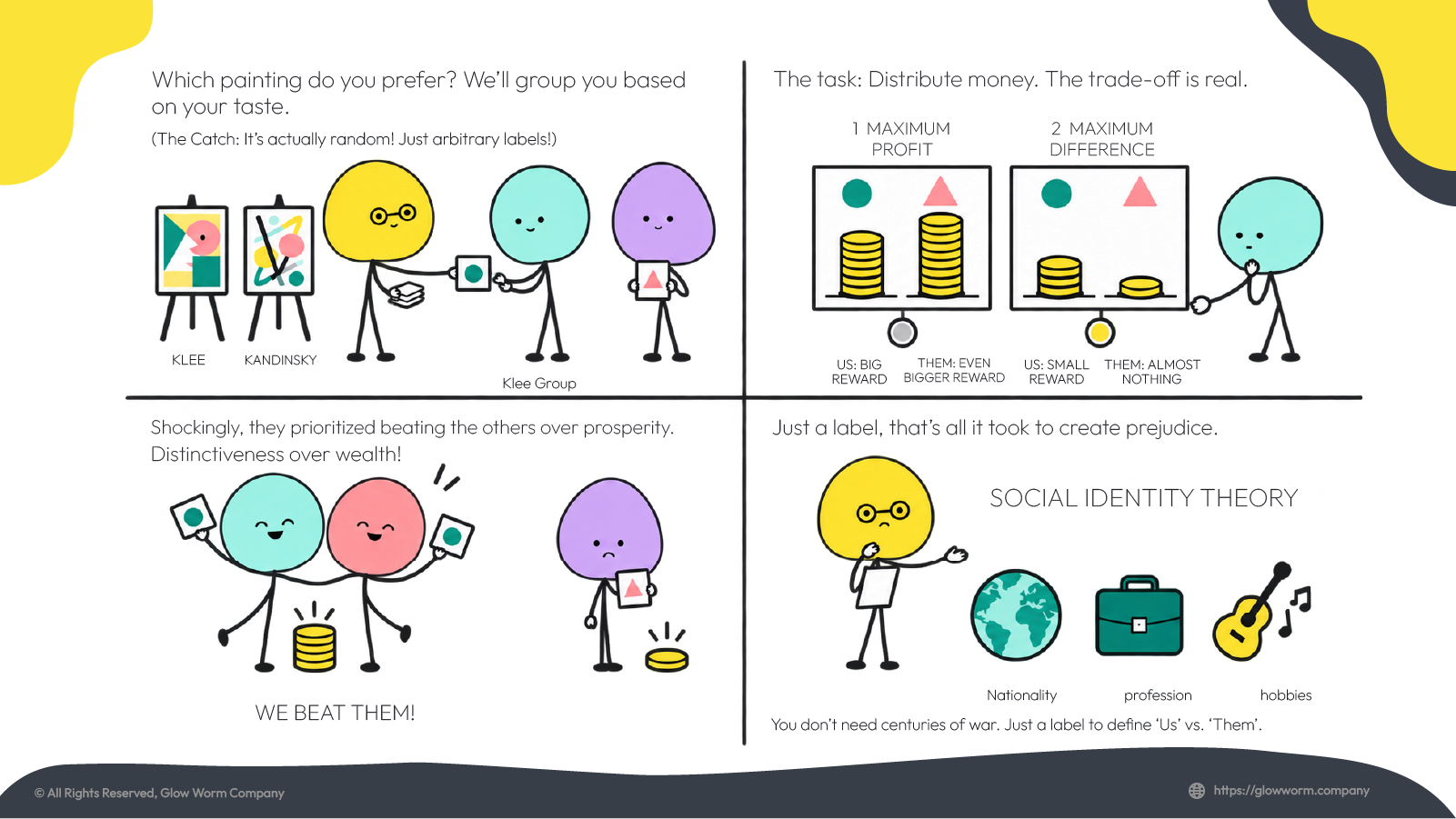
Tajfel brought young schoolboys, who did not know each other, into a lab and showed them slides of paintings by two abstract artists: Paul Klee and Wassily Kandinsky. The boys were asked which paintings they preferred. Based on their answers, they were told they were in the “Klee Group” or the “Kandinsky Group.”
But that was a lie. The boys were assigned to a group not based on their artistic taste, but randomly. The labels were arbitrary, meaning there was truly no difference between the groups.
Then, the boys were given a task: distribute small amounts of money to other participants using a matrix of choices. They couldn’t keep the money themselves; they could only give it to a member of their own group or a member of the other group.
As expected, the boys gave more money to members of their own group. But the real shock came when they were forced to make a trade-off. They were often presented with two types of choices:
- Maximum Profit: Your group gets a large reward, but the other group gets an even larger one.
- Maximum Difference: Your group gets a much smaller reward, but the other group gets almost nothing.
Shockingly, the boys frequently rejected the high reward. They were willing to sacrifice their own group’s wealth just to ensure they “beat” the other group by a wider margin. They prioritized distinctiveness over prosperity.
Tajfel had his answer. You don’t need centuries of war to create prejudice. You just need a label.
This led to the birth of Social Identity Theory, developed by Tajfel and his student John Turner. The core premise is simple but profound: A significant part of who we are (our self-concept) is defined by the groups we belong to. These groups can be based on nationality, religion, profession, gender identity, hobbies, or dozens of other categories. When you join, support, or identify with a group, you don’t just gain a community—you also take on that group’s ways of thinking, acting, and seeing the world. We don’t just have a personal identity (“I am funny,” “I like jazz”); we have a social identity (“I am a New Yorker,” “I am a Gryffindor”).
The 3 Steps of Social Identity
According to Social Identity Theory, we don’t just exist as isolated individuals; we define our place in the world using a three-step cognitive process. Think of this as the operating system your brain runs in the background of every social interaction.
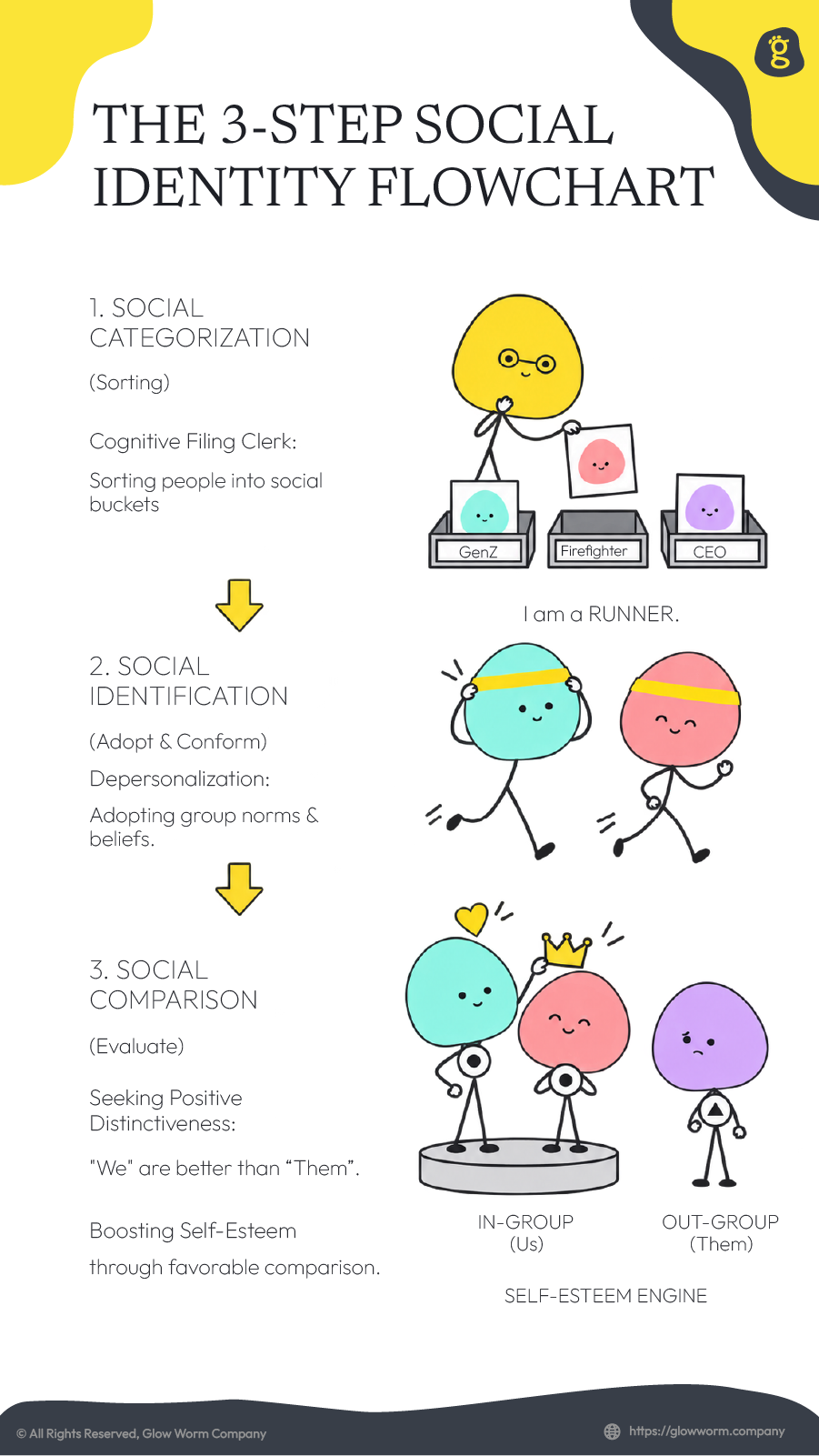
1. Social Categorization
First, we structure our understanding of the social environment. The world is too complex to treat every single person as a completely unique individual every second of the day. So, to save mental energy, we use cognitive shortcuts to organize people into pre-existing “buckets” provided by society: GenZ, firefighter, hipster, CEO, barista. Research suggests our brains can categorize a person’s social group (specifically things like race, gender, or age group) in less than 100 milliseconds- faster than the blink of an eye!
2. Social Identification
This is where we step into the picture. We don’t just categorize the world; we locate ourselves within it. We adopt the identity of the group we think we belong to and conform to its norms.
For example, if you decide to take up jogging and suddenly identify as a “Runner,” you don’t just run. You adopt the group’s norms. You buy the high-visibility neon gear. You start using words like “splits,” “PRs,” and “shin splints.” This is a process called depersonalization—where your individual quirks yield to group standards. You might even find yourself internalizing beliefs that differ from your usual preferences, simply because “that’s what runners do.”
Crucially, this identity is fluid. You might feel like a die-hard “Runner” at 6:00 AM, but by 9:00 AM, that identity recedes and “Professional Manager” takes the wheel. These shifts happen automatically to help us navigate different environments.
3. Social Comparison
Once we have identified with a group (the In-group), we need to assess its value. We do this by comparing it to other groups (the Out-group).
This is the critical pivot point of the theory. We don’t just want our group to be different; we want it to be better. We engage in a constant evaluation: Are we smarter than them? Are we faster? Are we more moral? We unconsciously look for ways to distinguish “Us” from “Them” that make “Us” look good. We tell ourselves, “We runners are disciplined and tough,” while implying, “Walkers are slow and get in the way.”
The Consequence: The Drive to “Win”
Why isn’t it enough to just be part of a group? Why do we need the rivalry?
Tajfel and Turner argued that this comparison is driven by a deep need for positive distinctiveness. Because our identity is tied to the group, our self-esteem is tied to the group’s status. If the group “wins” the comparison, we feel good. If the group “loses,” our self-image takes a hit.
This desire to win the comparison is what drives In-group Favoritism (giving our team the benefit of the doubt) and Out-group Discrimination (judging rivals harshly). Discrimination isn’t just random malice; it is a strategic (though often unconscious) move to make sure the comparison ends in our favor.
This often results in the Ultimate Attribution Error:
- When “We” are late:“We were late because the traffic was a nightmare.” (We blame the situation).
- When “They” are late:“They were late because they are lazy and unplanned.” (We blame their character).
The Double Edged Sword of Belonging
Social Identity Theory shows us that group membership is a mixed bag. It brings us immense joy, but it also creates the friction that fuels conflict. From Facebook groups to superhero fandoms and family dinner tables, the desire to belong and distinguish “us” from “them” shapes behavior everywhere.
Let’s look at a workplace example to see how this cuts both ways. Consider a tight-knit Marketing Department at a tech start-up. Inside the team, the vibe is electric. They have inside jokes about fonts, they bond over shared deadlines, and they feel understood. However, to boost their own distinctiveness, they unconsciously start to devalue the Sales team, viewing them as “pushy” and “unrefined.” Now this social identity dynamic can play out in two ways.
On the bright side, identifying yourself as part of the “Marketing Tribe” provides:
- A sense of belonging: You aren’t alone in your creative struggles or “writer’s block”—your teammates “get it.”
- Purpose: Shared goals give you direction. You aren’t just making a slide deck; you are executing a vision that unites the group.
- Self-worth: Group achievements become your achievements. When a campaign by the Department wins an award, your personal self-esteem gets a free boost.
Now, let’s look at it the other way. Unfortunately, the same mechanism that creates the team’s synergy creates a barrier against everyone else. When the need for “positive distinctiveness” goes unchecked, it leads to:
- Exclusion or pressure to conform: If the group culture becomes too rigid, you might feel pressured to agree with the majority or hide parts of your authentic self to “fit in.”
- Prejudice or conflict: To feel superior, the team creates a rivalry. Marketing might dismiss valid feedback from Sales or another function simply because “they don’t understand the brand,” creating an unnecessary wall.
- Uncertainty or identity shifts: If the company restructures and the Marketing team is disbanded, members may feel a profound loss of self, leaving them adrift and searching for a new identity.
How to Hack Your Reality
Now that you understand the machinery, you can take the controls. Understanding Social Identity Theory gives you a superpower: the ability to redraw the boundaries of “Us”.
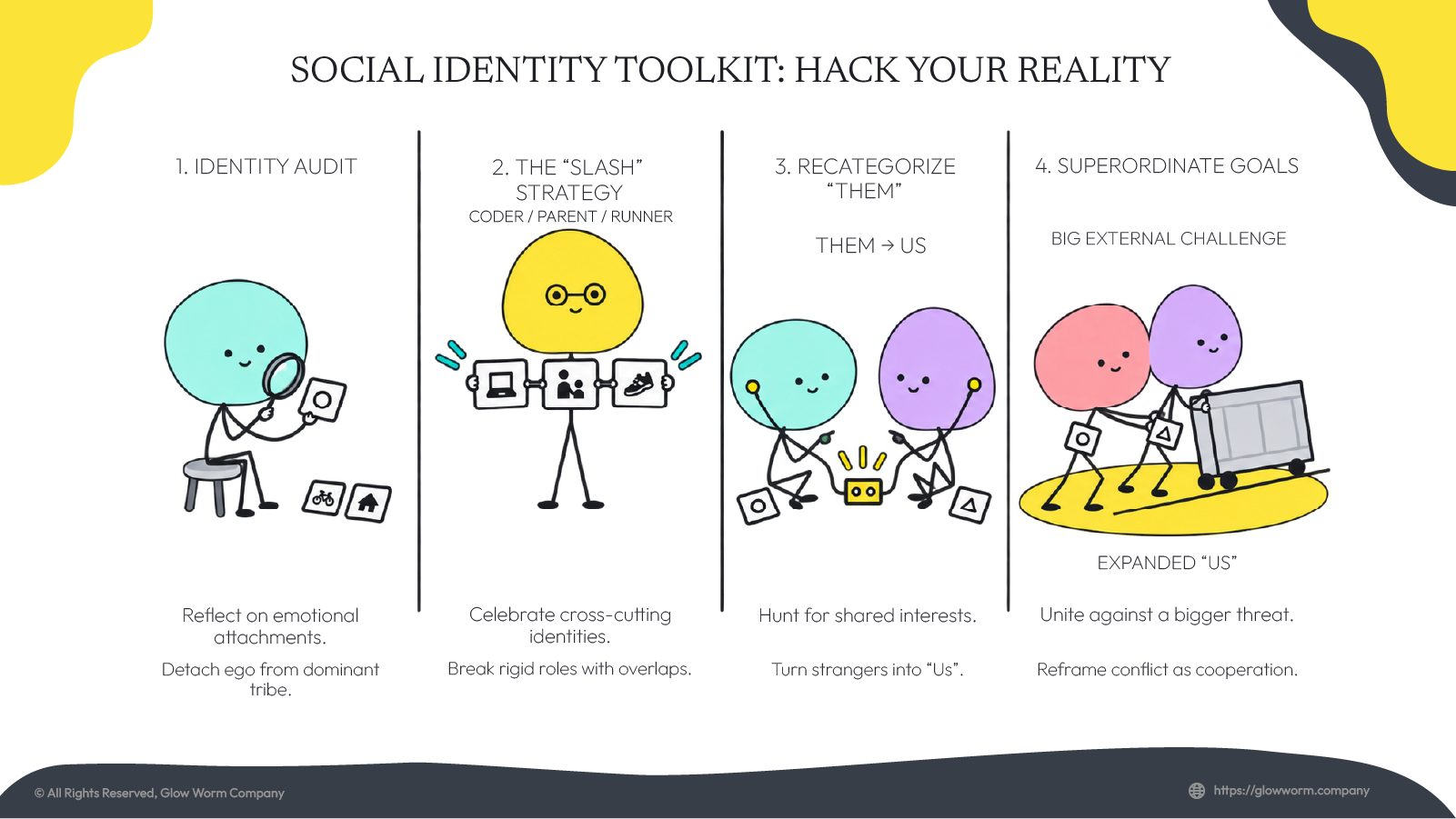
- Perform an Identity Audit: Take a moment to reflect on which groups dictate your emotional state. If a criticism of your company or a loss by your sports team ruins your entire week, your identity might be too fused with that group. Awareness is the first step to detachment; recognize that you are more than just a member of that one group.
- The “Slash” Strategy: In the workplace, rigid roles (Coder vs. Manager) create conflict. Actively celebrate “cross-cutting” identities. This taps into the concept of Intersectionality - the reality that we all exist at the crossroads of overlapping identities like race, gender, profession, and hobby. Acknowledging that a “Coder” is also a “Parent / Runner / Volunteer” creates overlaps with people in different departments. By highlighting these slash identities, you break down inflexible boundaries and spark collaboration.
- Recategorize the “Them”: In social settings, your brain automatically sorts strangers into the “Out-group.” Hack this bias by consciously hunting for a shared identity. If you discover a stranger also hates coriander or loves 90s Bollywood music, you have found a new “In-group.” By finding one shared category, you move them from “Them” to “Us,” instantly unlocking more empathy and trust.
- Establish Superordinate Goals: When tensions flare, don’t just try to resolve conflict. You need to change the category. Create a Superordinate Goal - a massive external challenge that requires everyone to cooperate. Reframe the problem so the enemy isn’t the other department, but a competitor or a deadline. When you shift from “Marketing vs. Sales” to “Us vs. The Loss of Market Share,” you force the “Us” circle to expand.
Beyond ‘Us’ vs. ‘Them’
Social Identity Theory teaches us that the lines we draw between people are imaginary. They are mental shortcuts, not physical walls.
While our brains are wired to seek out groups, we have the incredible cognitive power to choose which groups we embrace. We can choose to define our “In-group” narrowly (just people who look and think like us), or we can define it more broadly (humanity, community, colleagues).
So, the next time you find yourself screaming at the TV over a game you aren’t playing, or feeling that flash of annoyance at a coworker in a different department, take a beat. Recognize the machinery at work. Smile at your ancient, tribal brain. And then, make the conscious choice to widen the circle. Because at the end of the day, the biggest, most inclusive “In-group” of all is simply being human and that is a team worth cheering for!