Imagine you’re chatting with your colleague just a few minutes before they head into a big meeting. As they’re talking, you spot a very noticeable piece of spinach stuck right between their front teeth.
You have a choice. What do you do?
Do you stay quiet? You might think, “Oh, that’s so awkward. If I point it out, they’ll be embarrassed right before their presentation. It’s better if I just don’t say anything.” Or, do you find a quick, kind way to say, “Hey, quick heads up- you’ve got a little something in your teeth. I’d want someone to tell me!”
Which choice is actually kinder?
Staying silent feels polite, and you’re trying to spare their feelings. But really, you’re letting them walk into a room full of people with spinach on their teeth. The second choice might be slightly awkward for a second, but it saves them from a much bigger embarrassment later. It shows you’ve got their back.
This is exactly the problem that Radical Candor is designed to solve. It’s a simple framework from Kim Scott, a former leader at Google and Apple, that helps you navigate these moments- not just at work but also in your personal life! It’s all about being both kind and clear- showing you care enough about someone to tell them the truth, even when it’s a little hard.
Breaking it Down: The Four Quadrants
At its heart, Radical Candor is not a personality trait but a communication practice anyone can learn. It is what happens when you combine two fundamental things: Caring Personally and Challenging Directly. Think of it as a compass for conversation.
- Care Personally: This is the “kindness” part. It means you genuinely care about the person. You see their potential, you respect their abilities, and you want them to succeed. Without it, feedback can feel cruel.
- Challenge Directly: This is the “clear” part. It means you are willing to have uncomfortable conversations. You share your perspective directly rather than hinting or staying silent. You address issues head-on, preventing them from festering and becoming bigger problems later.
When you combine these two, you get Radical Candor. But when one is missing, you fall into one of three other, less helpful, quadrants.
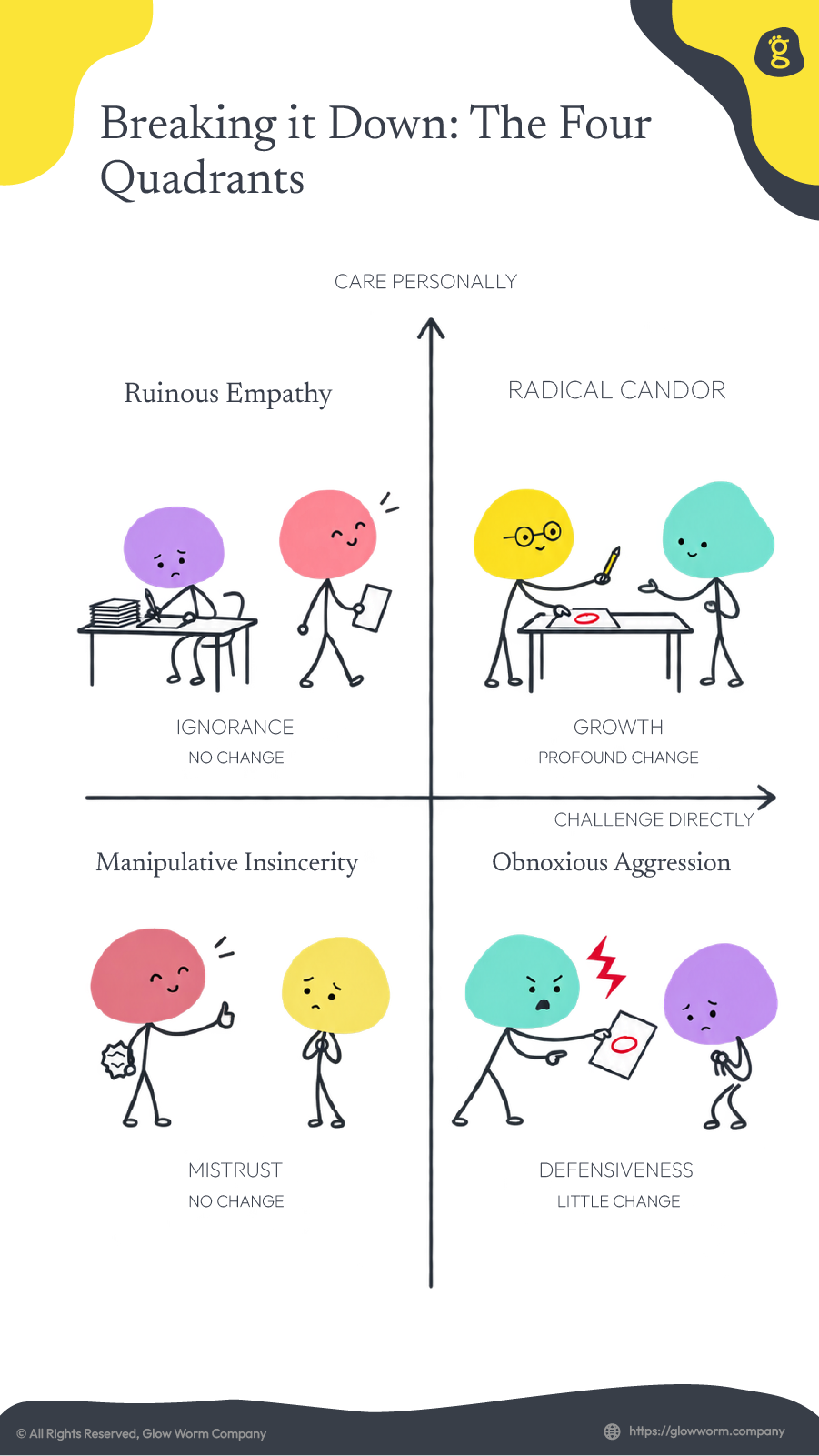
Radical Candor (Care Personally + Challenge Directly)
This is the goal. It’s both sincere and direct. It’s saying, “I’m telling you this because I care about you and your growth.”
- What it looks like: Your boss pulls you aside after a meeting and says, “I want to start by saying I really value your contributions. In that meeting, though, I noticed you said ‘um’ quite a bit, which seemed to distract from your excellent points. I struggled with this too, and public speaking classes really helped me. Would you be open to the company sponsoring a course for you?”
- The feeling: You feel supported, not attacked. The feedback is about your behavior, not your identity, and it comes with a genuine offer to help.
Ruinous Empathy (Care Personally without Challenging Directly)
This is the “nice” trap, like when you don’t mention the spinach stuck in your colleague’s teeth. You care, but you’re so focused on not hurting someone’s feelings that you fail to give them the feedback they need to improve. It feels kind, but it’s ultimately damaging.
- What it looks like: A team member consistently turns in work that isn’t up to standard. As their manager you may think, “Oh, they’re trying so hard, and I know they have a lot going on at home. I don’t want to demotivate them.” So, you say nothing and secretly stay late to fix their work.
- The feeling: The employee may feel lost and confused because they don’t know what they’re doing wrong. As the manager, you feel increasingly stressed and resentful as you shoulder the extra burden. The initial attempt to be ‘nice’ ends up hurting everyone.
Obnoxious Aggression (Challenge Directly without Caring Personally)
This is what many people fear feedback will be: brutal honesty without the kindness. It’s challenging someone without first showing you care. It’s being a jerk. This behavior creates a culture of fear.
- What it looks like: A family member says at a holiday dinner, “Wow, another slice of pie? You’ve really packed on the pounds.” It’s brutal honesty without a drop of kindness.
- The feeling: You feel humiliated and belittled. Trust is instantly destroyed and you’ll likely look at avoiding family gatherings in the future
Manipulative Insincerity (Neither Caring nor Challenging)
This is the worst place to be. It’s praise that isn’t genuine or criticism that is delivered passive-aggressively. It’s office politics and backstabbing. People say one thing to your face and another behind your back.
- What it looks like: A coworker is annoyed with you. Instead of talking to you, they complain to everyone else on the team, while being perfectly nice to your face.
- The feeling: This environment is toxic. There is no trust, and everyone is focused on political survival, not doing great work together.
What Does the Research Say?
Radical Candor isn’t just a nice idea—it’s backed by results. Studies show that teams and companies that embrace this kind of open, honest feedback see huge boosts in morale and engagement. But here’s the catch: a Gallup poll found that while most people want feedback, only about a quarter of employees feel the feedback they get actually helps them improve. This shows that how we say something is just as important as what we say.
Teams at companies like Google and Netflix, which have institutionalized direct but caring feedback, report higher levels of psychological safety—a key driver of innovation and collaboration. When feedback is delivered with Radical Candor, it helps people develop a growth mindset. It frames challenges not as failures, but as opportunities to learn and improve.
Radical Candor also helps us avoid a common mental trap of Fundamental Attribution Error: blaming someone’s character for a mistake instead of looking at their circumstances. For example, instead of thinking, “My roommate is so lazy for not doing the dishes,” this framework pushes you to think, “I care about my roommate, so I should ask if something is going on.” It encourages curiosity before criticism.
Making Radical Candor a Habit
This is a skill, and like any skill, it takes practice. You don’t have to become a perfect practitioner overnight. Here are a few simple, manageable ways to start.
The easiest way to start is to model the behavior you want to see. Ask your boss or a trusted peer for feedback first. This does two things: it shows you’re humble and willing to learn, and it gives you a chance to see how others approach feedback.
- What to say:“Could you tell me one thing I could do or stop doing that would make it easier to work with me?” or “How did that presentation land with you? I’d love any feedback you have.”
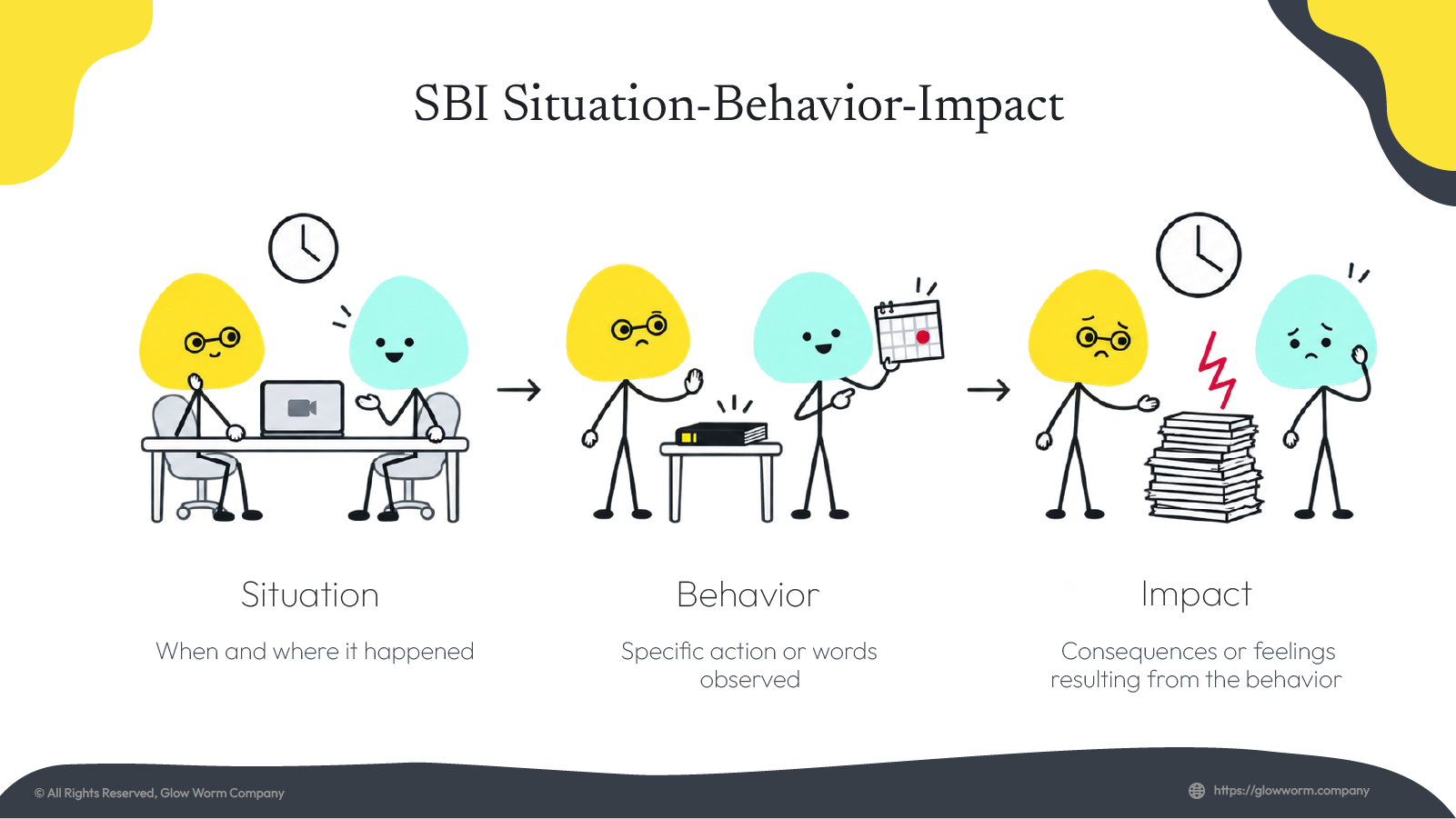
When you do give feedback, avoid vague statements. You could use the SBI Model (developed by Center for Creative Leadership) to structure your feedback.
-
S - Situation: Describe the specific context. Where and when did this happen?
-
“In the client call this morning…”
-
B - Behavior: Describe the specific, observable behavior. Don’t make assumptions about their intent.
-
“…when the client asked about our timeline, you gave an estimate without checking our project plan first.”
-
I - Impact: Describe the impact the behavior had on you, the team, or the project.
-
“The impact was that the client now has an expectation we might not be able to meet, and it puts our team in a difficult position.”
Putting it all together: “In the client call this morning (Situation), when the client asked about our timeline, you gave an estimate without checking our project plan first (Behavior). The impact is that the client now has an expectation we might not be able to meet, which puts our team in a difficult position (Impact).”
Pro-Tip: Always try to give feedback in private and as soon as possible after the event. Timely, private feedback feels like support; delayed, public feedback can feel like an attack.
Radical Candor isn’t just for criticism! It can also be used for giving praise that is specific and sincere, which is far more meaningful than a generic “good job.”
- Example:“When you took the time to plan our whole date night last Saturday (Situation & Behavior), it made me feel so special and cared for. It was exactly what I needed (Impact).”
Navigating the Nuances of Radical Candor
The world is complex, and Radical Candor isn’t a magic wand. Here are some important things to keep in mind:
- Power Dynamics Matter: Giving feedback to your boss is different from giving it to someone who reports to you. If you’re “challenging up,” it’s even more important to ensure psychological safety exists. Test the waters by asking for feedback first. If you’re a leader, it’s your job to prove you are open to being challenged.
- Cultural Differences: What is considered “challenging directly” in one culture might be seen as “obnoxious aggression” in another. It’s important to be mindful of cultural norms. The principle of Caring Personally remains universal, but how you Challenge Directly may need to be adjusted.
- It’s Not What You Say, It’s What They Hear: Your intent to be helpful doesn’t matter if the other person feels attacked. If someone tells you your feedback was harsh, don’t say, “I was just being radically candid!” Instead, ask, “How could I have said that better?”
- Gauge, Don’t Guess: After giving feedback, check how it landed. You can simply ask, “How does that land with you?” This turns a monologue into a dialogue and shows you care about their reaction.
It’s a Journey, not a Destination
Let’s be real. It will feel awkward at first. You will make mistakes. You might slip into Ruinous Empathy one day and worry you were Obnoxiously Aggressive the next. That’s okay. By embracing the principles of Radical Candor, we can move beyond the limitations of our ingrained communication habits and forge deeper, more meaningful connections with the people around us. It’s a journey that requires courage, vulnerability, and a genuine commitment to helping others and ourselves to be our best.