A brilliant idea, a critical insight, a vital question - all poised on the tip of your tongue in a meeting. But a little voice whispers, “What if they think I’m stupid? What if I embarrass myself? What if my boss gets mad?” So you stay silent. The moment passes and the idea remains unspoken.
Can you remember the number of times this has happened to you?
That crippling hesitation to self-reject is a response to a current or past environment that lacks psychological safety. It’s the silent enemy of innovation, quietly undermining teams and companies every single day. The key to curing this silent killer is a concept called psychological safety, a term coined by psychologist Carl Rogers in the 1950s and later used by Harvard Business School professor Dr. Amy Edmondson in her paper*, “Psychological Safety and Learning Behavior in Work Teams”* in the context of teams and workplaces.
Origin of Psychological safety in workplace
In her foundational 1999 paper, Edmondson defined psychological safety as “a shared belief that the team is safe for interpersonal risk-taking”. Her exploration began with studying hospital medical teams in the 1990s, trying to understand why some teams were better than others at preventing medication errors, with an initial hypothesis that the best teams would make fewer mistakes.
Instead, she found that they seemed to make more. Her ground-breaking discovery on deeper analysis was that they weren’t making more mistakes, but in fact, reporting mistakes more frequently. The highest-performing teams reported more errors because they felt safe enough to admit when a mistake happened. This allowed them to learn from it and prevent future occurrences. She realized that it wasn’t about the absence of errors, but the willingness to report them. And that willingness came from a shared belief that the team was a safe space for speaking up.
The Silent Saboteurs of Safety: What prevents people from speaking up?
Amy Edmondson’s book, The Fearless Organization, uses the 1982 Air Florida Flight 90 crash to show what happens when there’s no psychological safety. A rigid hierarchy prevented the co-pilot from insisting that the senior captain address the ice on the wings, a crucial issue that ultimately caused the crash. This tragic event highlights how a culture of fear can stop people from speaking up, even when lives are at stake. Other barriers to psychological safety include the fear of appearing incompetent, an ingrained authority bias, and cultural norms that favor polite silence. A focus on efficiency that discourages learning from errors, a pervasive blame game, and the lack of informal cues in remote work also contribute to these problems. Overcoming these challenges is essential for creating an open and innovative environment.
Edmondson’s Four Performance Zones
It’s crucial to understand that psychological safety isn’t about being “nice” or “soft”. In fact, Edmondson’s model brilliantly illustrates its role by pairing it with accountability. The model uses a four-quadrant chart to define distinct performance zones.
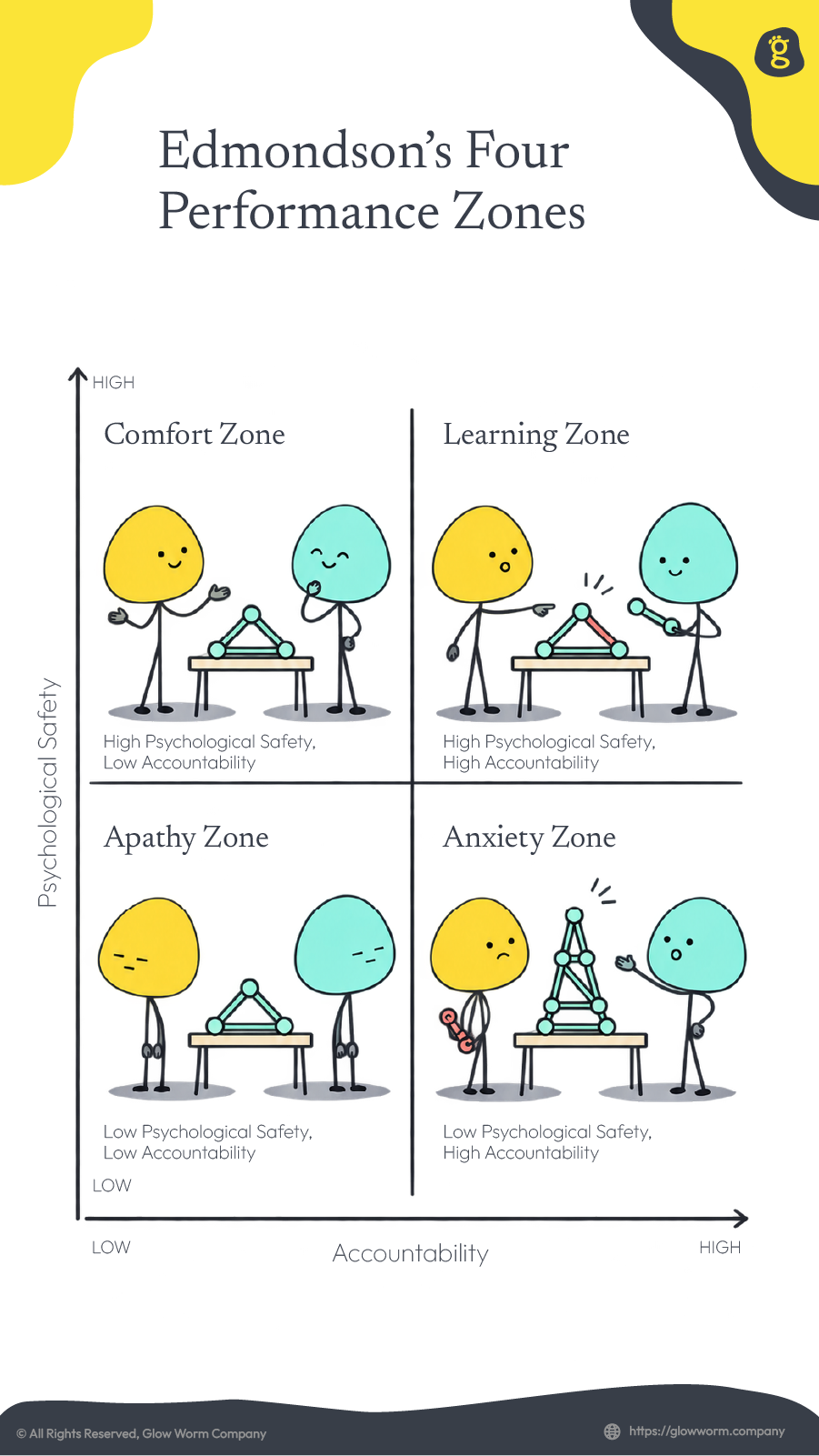
- The Apathy Zone (Low Psychological Safety, Low Accountability): This zone is an environment where no one cares and little gets accomplished due to a complete lack of both psychological safety and accountability.
- The Anxiety Zone (Low Psychological Safety, High Accountability): A culture driven by fear, where high demands for results and a lack of psychological safety lead to a stressful environment. Mistakes are hidden, and speaking up is avoided. There is a lack of open communication.
- The Comfort Zone (High Psychological Safety, Low Accountability): This quadrant fosters a friendly atmosphere, but the absence of accountability can lead to complacency and underperformance. Teams may feel safe but without a drive to challenge themselves, they risk growth.
- The Learning Zone (High Psychological Safety, High Accountability): This is the optimal state for any team. In this zone, individuals feel safe to voice concerns, challenge ideas, and admit mistakes while also being held to high standards. This dynamic blend of trust and accountability fuels continuous learning, innovation, and sustainable high performance.
This model underscores that psychological safety is not an excuse for a lack of discipline; rather, it’s the essential bedrock upon which ambitious, results-driven teams are built to thrive.
What does research say?
There is empirical evidence to show how psychological safety can improve employee performance, engagement and retention. For example, In 2012, Google embarked on a major internal study,Project Aristotle, to identify the characteristics of its most effective teams. After analyzing data from over 100 teams, researchers were surprised to find that psychological safety was the single most important factor in team effectiveness. The study revealed that teams with a high degree of psychological safety outperformed others on all key metrics, including innovation, productivity, and employee retention. This research provided powerful, large-scale evidence that the “who” on a team was less important than the “how”—the culture of trust and respect that allows for open communication and vulnerability.
Leading thinkers in organizational culture, from Timothy Clark to Brené Brown, consistently identify psychological safety as the essential foundation for high performance. As a roadmap for leaders, it’s the environment Edmondson describes, without which a culture of silence persists. Brené Brown’s research defines vulnerability- a core component of psychological safety - as “uncertainty, risk, and emotional exposure.” Without a safe space to be vulnerable, there’s no genuine connection, honest feedback, or true innovation. The concept is further supported by Daniel Coyle’s The Culture Code, which highlights how successful groups actively “build safety” and “share vulnerability.” Finally, Kim Scott’s Radical Candor framework reinforces this by advocating for leaders to “Care Personally” while “Challenging Directly”—the very essence of Edmondson’s “Learning Zone.” These frameworks all converge to a single truth that the bedrock of any thriving team is their ability to speak up and take risks without fear.
The Power of a Fearless Culture
When psychological safety is high, teams become unstoppable. It positively impacts performance as it* unleashes innovation* by allowing people to share creative ideas and experiment without fear. This environment also boosts learning by reframing mistakes as valuable data points, which enables teams to openly discuss errors and find solutions. Furthermore, psychological safety enhances problem-solving by ensuring that everyone feels safe to contribute their diverse perspectives, leading to more comprehensive solutions. The feeling of being safe, respected, and valued also improves engagement and retention, as employees are happier and less likely to leave their jobs.
Ultimately, at its core, psychological safety fosters trust, which is the foundation for honest communication and strong team cohesion.
Actionable Steps: Cultivating a Fearless Culture
Creating a psychologically safe environment requires intentional effort from everyone. Here’s how different people can implement it in both their personal and professional lives.
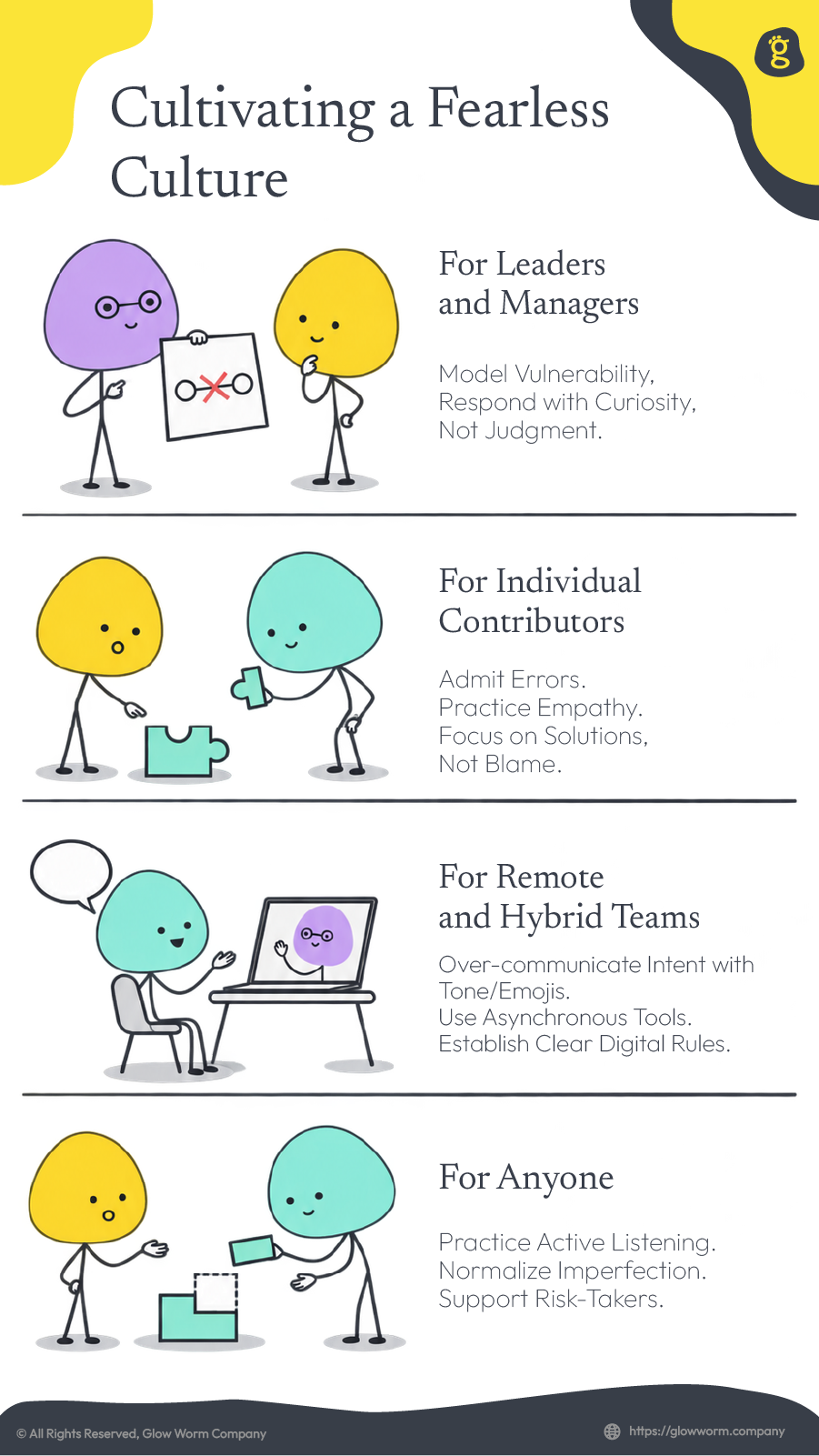
- For Leaders and Managers
Leaders can model vulnerability by admitting their own mistakes and framing them as learning opportunities. They can actively invite participation by asking questions like, “What am I missing?”, and respond to inputs shared with curiosity, not judgment. It’s also vital to set clear expectations that while poor performance is not acceptable, reporting errors is.
- For Individual Contributors
Team members can be vulnerable by admitting their own errors and asking for help. They can practice empathy by actively listening and asking questions to challenge ideas constructively instead of making direct criticisms. Supporting colleagues who take risks and focusing on solutions rather than blame also helps build a safe culture.
- For Remote and Hybrid Teams
In remote settings, it could be helpful to explicitly communicate the intent by using emojis and clear, complete sentences to convey tone and utilize asynchronous tools for sharing questions or ideas without the pressure of live meetings. Another tip is establishing clear rules of engagement, like using a hand-raise feature, and for managers, scheduling informal one-on-one check-ins to create a safe space for employees to voice concerns.
- For Anyone who wants to build a psychologically safer place
Anyone can foster psychological safety by* asking “How can I help?” and practicing active listening. You can offer constructive feedback with care, and acknowledge your own learning journey to normalize imperfection.* Most importantly, support others who speak up to reinforce that taking an interpersonal risk is valued and safe.
The Challenges of Psychological Safety
While psychological safety is a valuable tool, it faces challenges when taken to an extreme or misunderstood, especially when it’s not balanced with accountability. Excessive psychological safety becomes about being nice and making people comfortable. This can harm performance by encouraging complacency, as employees may believe there are no serious consequences for mistakes. This can jeopardize productivity, innovation and accuracy. This can also cause them to be distracted from their core tasks, focusing on less important work. The core issue lies in the mismatch with accountability. A truly effective workplace is one where managers can provide critical feedback and address performance issues constructively without undermining the feeling of safety.
The Future is Fearless
Psychological safety is a hard requirement for success in our fast-paced world. It’s the oxygen that fuels innovation, resilience, and human flourishing in the workplace. By understanding this concept and taking small, daily actions, we can each create environments where ideas flow freely, mistakes become lessons, there is a culture of high performance and every voice contributes to a better, more fearless future.