Whether we’re around the dinner table or the conference table, we all share the simple need: to be heard and understood. It’s the ‘secret sauce’ that keeps our personal lives meaningful and our work teams actually working. But in the daily grind, it’s easy to lose that connection, often leaving us feeling worlds apart from the very people we’re trying to support.
Perhaps you’ve tried to express appreciation to a colleague, but the words felt awkward or landed flat. Or maybe you’ve attempted to share a personal need with a loved one, only to feel frustrated and unheard. In other moments, you might try to offer supportive feedback, but are met with defensiveness.
These everyday interactions, the good, the neutral, and the challenging all reveal a simple truth: the way we communicate can either build walls or open gateways. It can create distance, or it can forge a path to the genuine connection we’re seeking.
The good news? We can learn to express ourselves with clarity and listen with genuine empathy. Focusing on the content of our needs rather than our judgments allows us to transform difficult conversations into shared discoveries. This way of structuring our dialogue turns a personal disagreement or a work conflict into an opportunity for a stronger bond.
For many of us, the specific skills to navigate life’s moments with this kind of grace and effectiveness were simply never explicitly taught. This is where Non-violent communication comes in. It’s a guide for expressing ourselves and listening to others in a way that can transform challenging interactions into opportunities for deeper understanding and stronger bonds.
Origin of Non-violent communication
The term Non-violent communication was coined by Marshall Rosenberg. His lifelong journey to understand and reduce violence began in 1940s Detroit, rooted in his childhood experiences as a Jewish boy facing racism in his neighborhood.
Later, working as a clinical psychologist in the 1960s, amidst the intense racial divisions of the Civil Rights Movement, he observed a heartbreaking paradox: people were desperate to be understood but used words that only fueled arguments and deepened their fracturing. Inspired by non-violent leaders like Gandhi and King Jr., Rosenberg forged Non-violent communication as a revolutionary method designed to help connect people at the level of universal human needs.
What Is Non-violent Communication, Really?
At its heart, Non-violent communication is a practical framework for communicating with empathy and clarity at all times.
It’s a way to help you express yourself honestly while listening to others as you move past the blame. Non-violent communication is rooted in a simple insight: most human conflict comes from how we say things, not what we’re trying to say. It helps us see that beneath our words and the words of others, are often unmet needs, quietly asking to be understood.
A Look at the Research
Research continues to reveal the quiet, transformative power of Non-violent communication. It has shown a remarkable ability to reshape environments as starkly different as prison yards and hospital wards into places of profound empathy and human connection.
A 2017 study with nursing students, who face the daily stress of human suffering, found that Non-violent communication training strengthened their empathy and communication skills. This helped them build more trusting and supportive relationships with patients and colleagues.
Similarly, a 2007 study with incarcerated individuals (The Freedom Project) found that Non-violent communication training led to decreased anger while simultaneously boosting self-compassion and resilience, eventually leading to reduced re-incarceration rates.
The Core Practice: OFNR framework
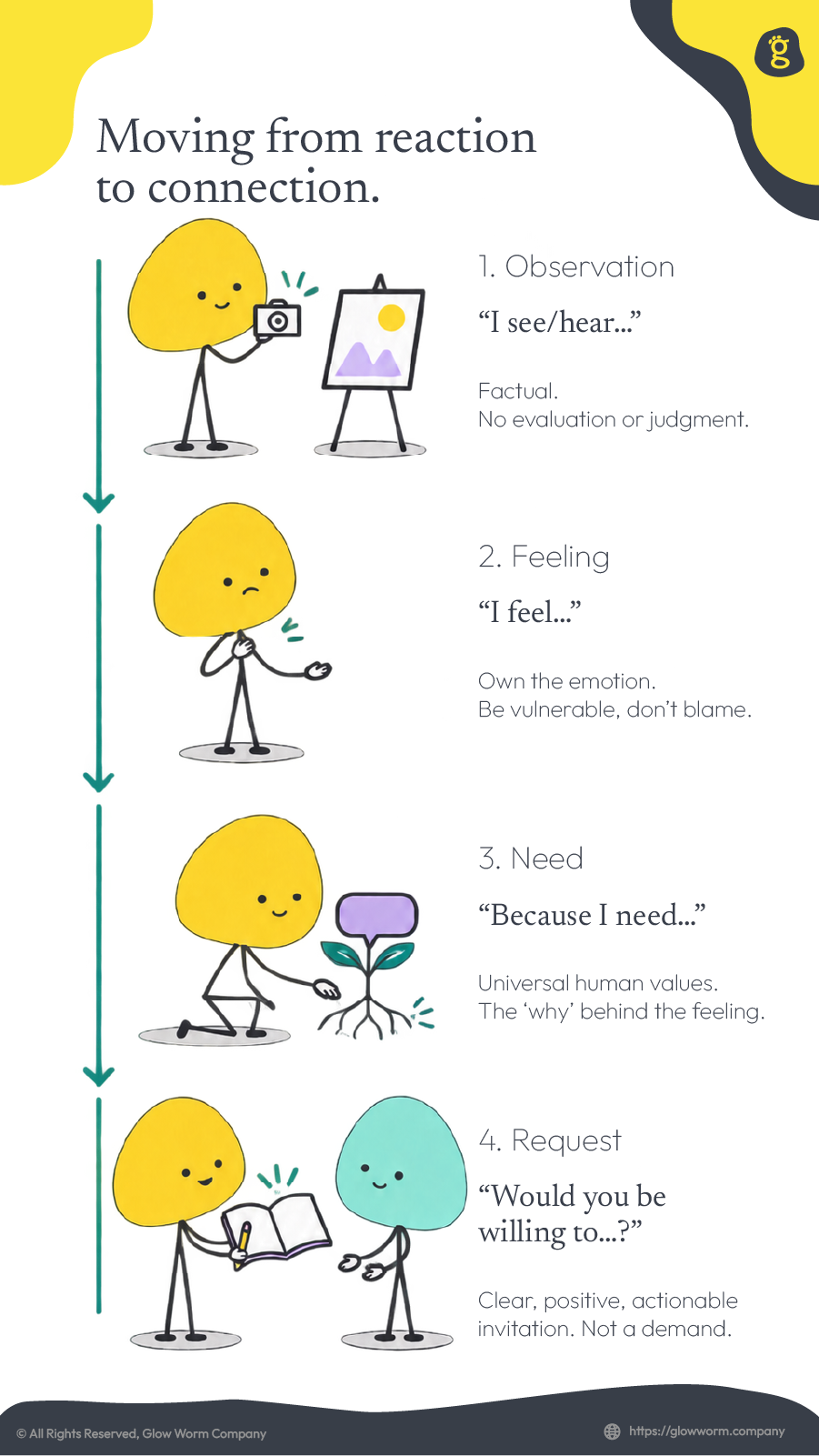
Dr. Rosenberg developed a straightforward, four-part model to guide these interactions, known as OFNR (Observation, Feeling, Need, and Request). Think of it as a compass to help you find your way in a conversation.
1. Observation: “I see/hear…”
State what you’re observing factually, without adding any evaluation or judgment. Observations are hard to argue with, whereas interpretations or judgments often put people on the defensive.
- Instead of: “You are always undermining me in meetings.” (A judgment.)
- Say: “During today’s presentation, when I was sharing the budget proposal, I noticed you interjected three times while I was speaking.” (A specific observation.)
2. Feeling: “I feel…”
Identify the emotion you’re experiencing as a result of your observation. Own your feeling, rather than implying someone else “made” you feel it. This is about vulnerability, not blame.
- Instead of: “You make me feel incompetent when you do that.” (Blaming.)
- Say: “When that happened, I felt flustered and discouraged.” (Owning the feeling.)
Use specific words (like “frustrated,” “anxious,” “joyful,” “relieved”) so the listener can better understand your experience, which strengthens the connection. You can also use our custom ‘Friending my feelings’ poster for this.
3. Need: “I need…”
Express the underlying universal human need that isn’t being met. This shifts the conversation from what’s “wrong” with the other person to what’s important to you (like respect, connection, safety, or understanding).
- Instead of: “I need you to stop being so rude.” (Still a judgment.)
- Say: “…because I have a strong need for preparation to be respected and to be fully heard when I am sharing information.”
4. Request: “Would you be willing to…?”
Make a clear, positive, and actionable request that could help meet your needs. You’re inviting collaboration, not demanding compliance. Ask for what you do want, not what you don’t want.
- Instead of: “Can you just stop interrupting me?” (A “don’t” request.)
- Say: “Would you be willing to jot down your questions and wait until I finish my current slide before sharing them in future meetings?” (A clear, “do” request.)
Non-violent communication Mindset and Skill
To use the OFNR framework effectively, it helps to adopt a supporting mindset and a skill.
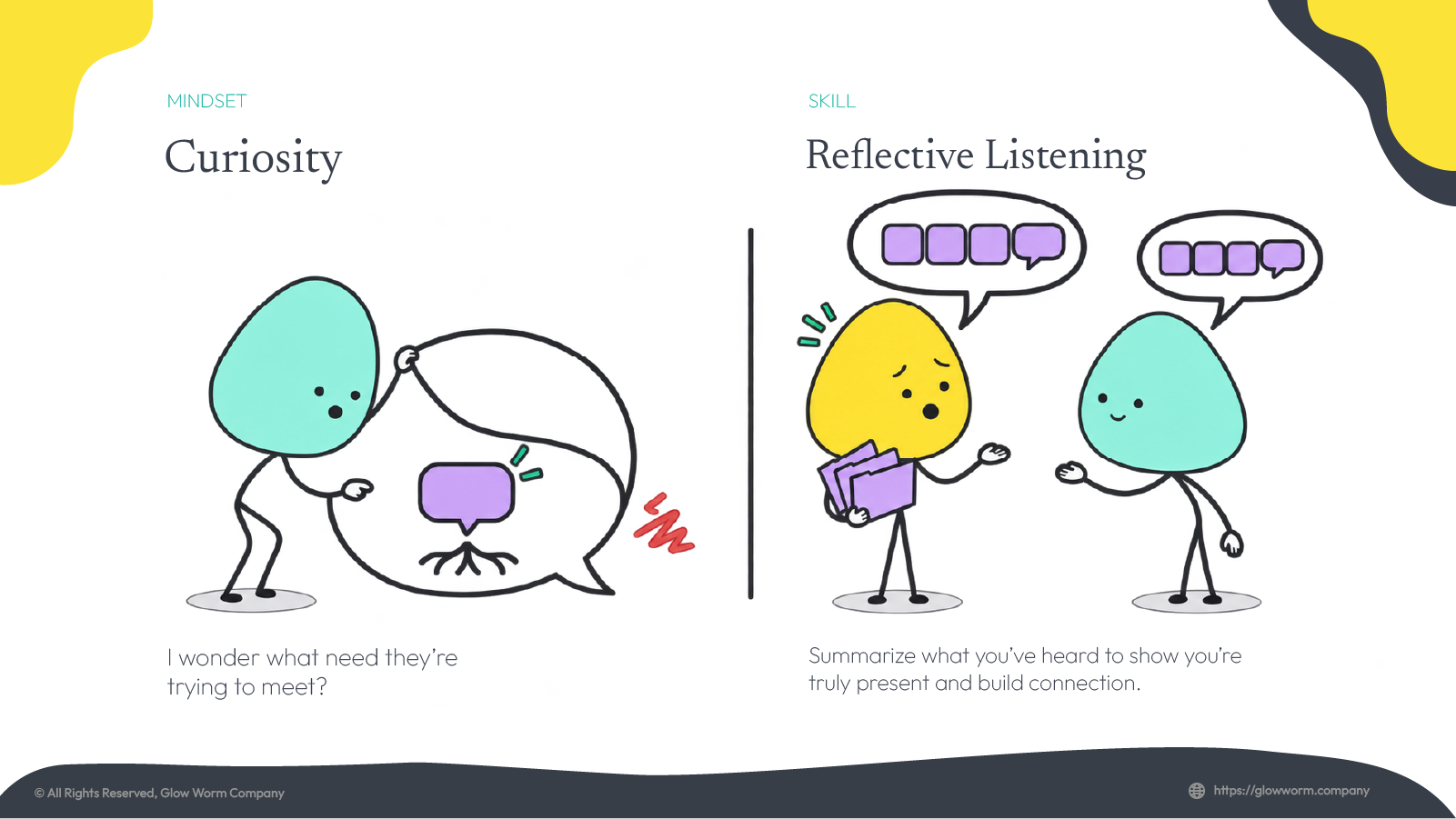
A crucial mindset is curiosity. This is the internal choice to believe that the other person’s actions make sense to them, even if we don’t understand why. It shifts us from assuming blame (“They’re being difficult”) to asking questions (“I wonder what need they’re trying to meet?”).
A powerful mindset for connection is Active Listening, being fully present and focused on understanding rather than responding. While active listening involves many non-verbal cues, a specific skill that makes the speaker feel truly heard is reflective listening. This is the verbal action of summarizing what we’ve heard in our own words (e.g., “So, you’re feeling overwhelmed because you’re juggling three big projects right now?”). This shows we’re genuinely trying to understand, not just waiting for our turn to talk.
This combination is vital when strong emotions like anger arise. By applying curiosity to our own anger, we can pause, identify our judgmental thoughts, and connect with our own unmet needs. Then we can express them clearly, creating a dialogue instead of a fight.
Receiving in Non-violent way
While the OFNR framework is an excellent tool for self-expression, true connection requires an equal emphasis on the art of receiving non-violently by expanding our capacity to empathically hold space for others. This shift can be understood through the lens of Co-Active’s three levels of listening, moving us beyond our default state of Level 1 (internal) listening, where we are consumed by our own chatter, urge to interrupt, or desire to give advice. Instead, receiving non- violently demands that we become fully present, adopting Level 2 (focused) listening to give the speaker undivided attention.
We must then deepen this awareness to Level 3 (global) listening, where we attune ourselves to what lies “behind the words,” listening not just for content but for the underlying feelings and unmet needs driving their statement, understanding, for example, that a cry of “You never listen!” may actually be an expression of loneliness and a need for connection. We validate this deep listening by gently paraphrasing and reflecting back what we have understood, ensuring the speaker feels truly heard.
Crucially, maintaining this receptive space also requires self-awareness; if we notice our own triggers surfacing and blocking our ability to listen, it is vital to take a compassionate time-out to regulate ourselves before returning to the dialogue.
Starting with Ourselves: The Inner Work of Non-violent communication
Non-violent communication is not only a tool for communicating with others but it is also a powerful way to build self-compassion.
We can use the framework to recognize and disarm our inner critic. When you catch yourself thinking, “I’m so stupid,” you can translate that self-judgment. The feeling might be “frustrated” or “disappointed,” and the unmet need might be “for competence” or “for wisdom.”
This moves us from punishing ourselves with guilt to a compassionate process of learning from our mistakes. It helps us transform actions motivated by pressure (“I have to…”) into conscious choices (“I choose to…”) that are connected to our own needs, fostering a sense of freedom and personal power.
Common Stumbles (And That’s Okay!)
As you start, practicing Non-violent communication can feel awkward or challenging. This is completely normal. Here are some common hurdles and gentle reminders:
- “It feels robotic or inauthentic.”
It’s like learning a musical instrument, it’s going to feel awkward at first. Be patient. Over time, you’ll find your own natural voice.
- “What if the other person isn’t interested or doesn’t use Non-violent communication?”
You can only be responsible for your side of the conversation. Non-violent communication is powerful even if only one person is using it, because empathetic listening can de-escalate tension all by itself.
- “What if I’m too upset to use it?”
That’s a sign you need Non-violent communication for yourself first. Take a time-out. Use the OFNR framework internally to understand your own feelings and needs before trying to communicate them externally.
- “It doesn’t ‘work’ (they still said no).”
The goal of Non-violent communication isn’t to get your way or control the outcome. The goal is to build a quality of connection where everyone’s needs matter. Hearing a “no” clearly is also a form of successful communication.
Your journey to Non-violent communication
Non-violent communication is a lifelong practice, not a quick fix. By integrating these ideas, you may find that it fundamentally transforms how you connect.
It can help reduce conflict by addressing the root of disagreements, unmet needs, while also strengthening everyday communication. Over time, it shifts interactions from a “you vs. me” dynamic to a more collaborative “us with the problem” approach, building deeper trust at home and at work. As you get better at identifying your own needs, your self-awareness and empathy naturally grow.
This journey, from conversation as a transaction to communication as a genuine connection, is one of the most rewarding we can take. We invite you to embrace it with curiosity and self-compassion.