We’ve all heard the advice: “The best way to learn is by doing”. We’re told to embrace failure, learn from our mistakes, and treat every experience as a lesson.
But let’s be honest, how often does that actually happen?
More often, we hit a roadblock. We try a new recipe, and it’s a culinary catastrophe. A project at work misses a deadline. We have a recurring, frustrating argument with a partner. Our takeaway from these moments isn’t a neat, tidy “lesson learnt!” It’s more a vague sense of frustration, embarrassment, or defeat. We might think “Well, I’m never doing that again!” and try our best to forget it all. The experience happens, but the learning doesn’t stick.
The truth is that experience alone is a terrible teacher! It’s just raw data. True learning, the kind that sticks with you and makes you smarter, more skilled, and more resilient, doesn’t come from just doing. It comes from a deliberate process of connecting our actions to their outcomes.
The Experiential Learning Theory is a simple framework that acts as an operating system for turning your frustrating, confusing experiences into genuine expertise. The model was developed in the 1970s by David A. Kolb, an educational theorist who wasn’t satisfied with the traditional “teacher talks, student listens” model. He knew learning was messier and more personal than that. Standing on the shoulders of giants like Jean Piaget, Kurt Lewin and John Dewey, Kolb synthesized their ideas into a simple, elegant cycle that explains how we can actually learn from our experiences. It’s not just an academic concept but a practical map for getting better at anything- whether you’re trying to master a new skill, lead a team, navigate a complex career move, or even improve your relationships.
The Model: Your 4 Stage Map for Learning
Imagine Kolb’s Model as a continuous spiral. You can jump on at any point, but to really learn, you need to visit all four stops. To see it in action, let’s track two parallel quests:
Personal Quest: Baking your first sourdough loaf.
Work Quest: Delivering a big, important presentation.
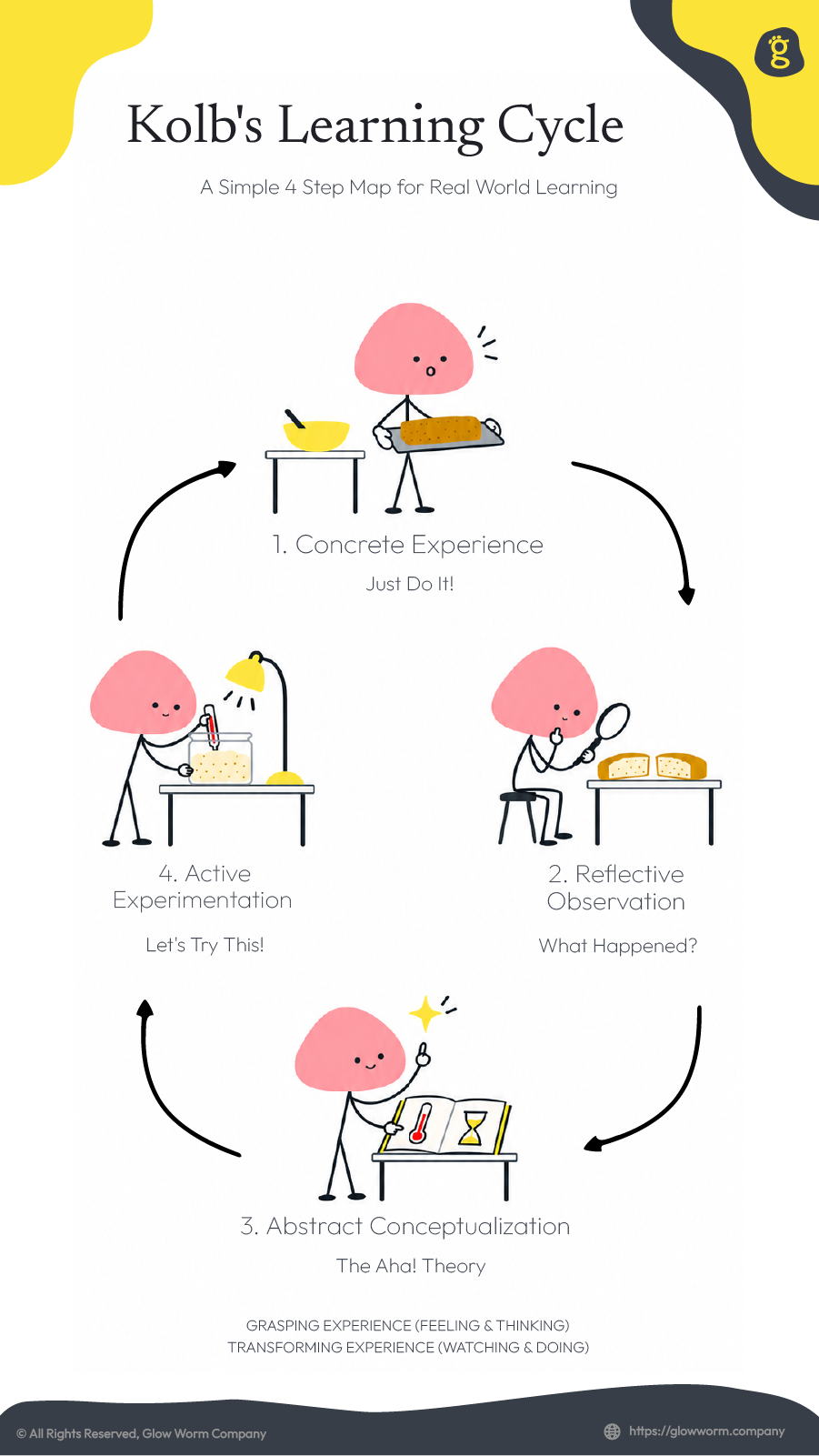
Stage 1: The “Just Do It” Stage (Concrete Experience)
It’s the actual experience, the raw data of life. You jump in, get your hands dirty, and feel what happens.
Sourdough Quest: You’ve watched a few YouTube videos. You’re excited! You mix the flour, water, salt, and your precious starter. You knead the dough (Is it supposed to be this sticky?), let it rise (Is it rising at all?), and finally bake it. You pull it out, and… it looks like a brick. It tastes okay, but it’s dense enough to use as a doorstop.
Work Quest: You’ve built your slides. You stand up in front of your team and the stakeholders to present. You notice people checking phones. You stumble over a stat. A VP asks a question that throws you off, and you finish with a weak, “So… any questions?” You feel that pit in your stomach.
Stage 2: The “What Just Happened?” Stage (Reflective Observation)
Now, you step back. You stop doing and start watching. You become an observer of your own experience, replaying the events in your mind from different perspectives. You ask, “What really happened here?”
Sourdough Quest: You sit down with your brick-loaf and think: “Okay, let’s review.” You remember the dough felt incredibly wet and was impossible to handle. You recall that the dough never seemed to double in size. You also remember you got impatient and cut the proofing time short. You are reviewing and reflecting.
Work Quest: Back at your desk, instead of burying the shame, you pause and reflect. “They checked out around slide 4. That’s when I read three paragraphs of text off the screen. And when the VP asked about the budget, I got defensive instead of just checking the numbers.I was so focused on my script that I wasn’t reading the room.”
Most people unknowingly get stuck here. They either stay trapped in reflection without insight, or jump straight back into action without learning anything new
Stage 3: The “Aha!” Stage (Abstract Conceptualization)
This is where you connect the dots. You take your reflections and try to form a general rule, a theory, or a principle. You move from the specific “what happened” to the general “why it happens.” This is the lightbulb-over-the-head moment.
Sourdough Quest: You do a little research. You read a blog post and realize, “Ah! Cold kitchens slow down yeast.” You form a new theory: Temperature and time are critical variables I ignored.
Work Quest: You think about great presentations you’ve seen. The lightbulb goes on: “No one likes being read to. Slides should be visual. And a presentation is a conversation, not a lecture or a performance.”
Stage 4: The “Let’s Try This!” Stage (Active Experimentation)
This is where you close the loop. You take your new theory and use it to plan your next attempt. You are actively testing your ideas to see if they hold up in the real world. This isn’t just a repeat performance; it’s a deliberate, modified action.
Sourdough Quest: Armed with your new theory, you plan your next bake. You use 5% less water to make the dough more manageable, and let the dough proof inside the oven with just the light on to create a warmer, more stable environment.
Work Quest: You have a smaller presentation next week. You build slides with only one key idea and one strong image per slide. You also purposefully pause twice and ask the audience a direct question.
This is how true improvement happens. You’re not just hoping for a better result; you’re engineering it based on what you’ve learned!
Why This Loop Changes Everything
This cycle might seem simple, but applying it has profound effects on how you live and work.
On a personal level, this model is a powerful antidote to a “fixed mindset.” When you have a “brick-loaf” moment and just quit, you’re telling yourself, “I’m just not a baker.” That’s a fixed mindset. But when you move to Stage 2 (Reflection), you’re changing the narrative. The failure isn’t you; it’s a process that can be analyzed and improved. The story becomes, “I’m not a good baker yet, but I just learned what to try next.” This is a Growth Mindset that builds resilience, curiosity, and a powerful sense of agency over your own life.
On the level of Organisations and teams, this framework has far-reaching effects. Consider a team that hits a roadblock with a project (Stage 1) and immediately starts blaming each other (no Stage 2). It can lead to a toxic work environment and stagnation in the project
But a team that builds in time for a “post-mortem” or “retrospective” is purposefully engaging in Reflective Observation. They ask, “What happened? What went well? What didn’t?” Then they brainstorm solutions (Stage 3) and agree on “action items” to try in the next project (Stage 4). Over time, teams that practice this cycle don’t just improve performance; they build shared judgment, psychological safety, and strategic clarity. This is called a learning culture. It’s the difference between a team that repeats the same mistakes and one that constantly innovates and evolves.
From a Cycle to a Style
Kolb’s second brilliant insight was that while everyone uses this cycle, we all have a preferred way of entering and navigating it. This preference gives rise to four distinct learning styles.
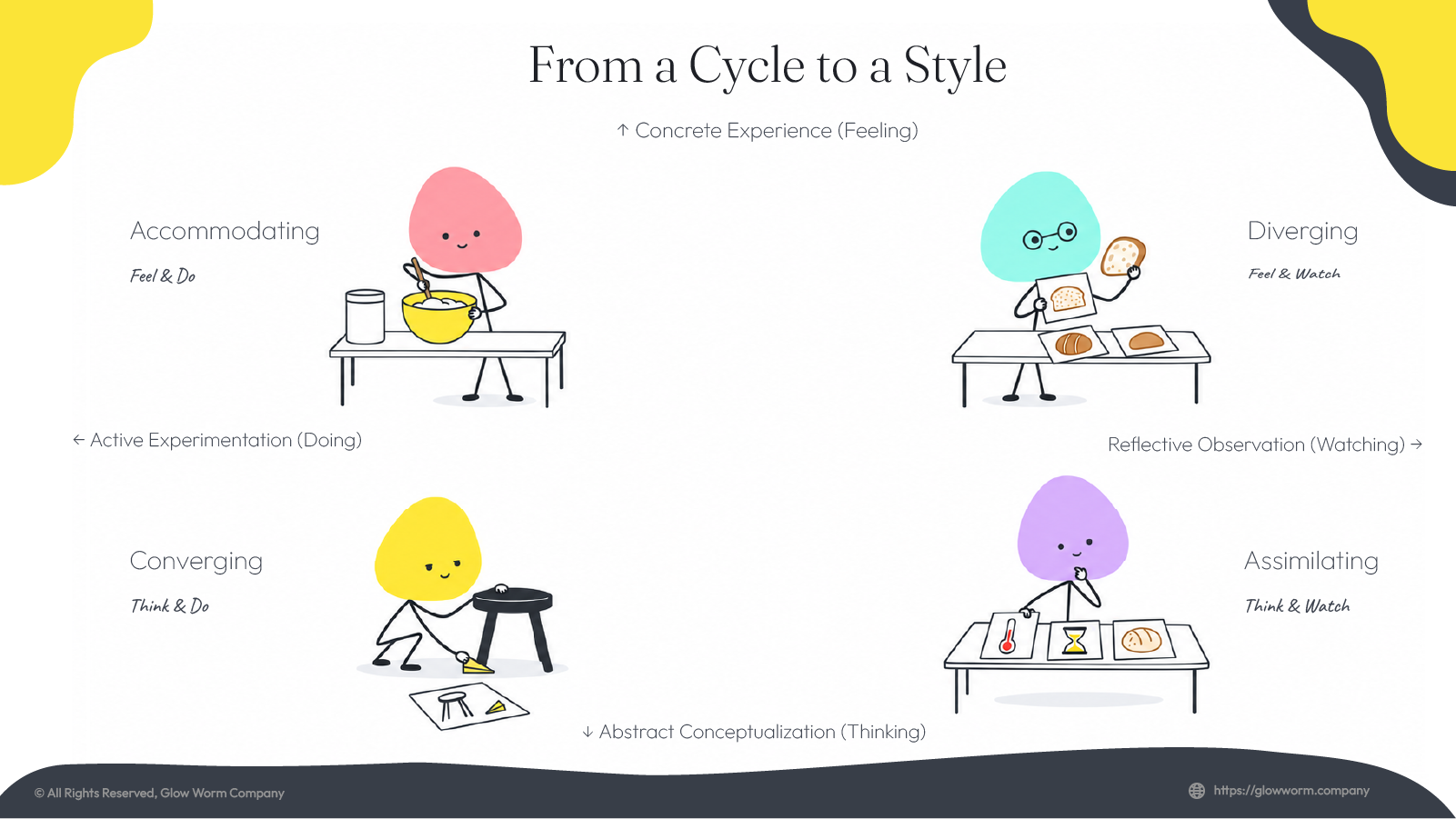
Understanding your style isn’t about boxing yourself in. It’s about recognizing your natural strengths and identifying which stages of the cycle you might be skipping.
Divergers excel at brainstorming and seeing the big picture. They are imaginative, people-oriented, and love to gather information.
- Strengths: Concrete Experience & Reflective Observation.
- Asks:“Why?” or “What are all the possibilities”
- You might be a Diverger if: You’re the friend who listens to a problem and helps someone see it from five new angles. At work, you excel at brainstorming and understanding customer or team feelings.
Assimilators are masters of logic and theory. They love to take vast amounts of information and organize it into a neat, conceptual model.
- Strengths: Reflective Observation & Abstract Conceptualization.
- Asks:“What is the model?”
- You might be an Assimilator if: You enjoy research, create detailed plans, and build theoretical frameworks.You’d rather understand the science of sourdough before you ever touch the flour.
Convergers are practical problem-solvers. They take a theory and immediately look for its real-world application. They are decisive and thrive when there’s a single best answer.
- Strengths: Abstract Conceptualization & Active Experimentation.
- Asks:“How does this work?”
- You might be a Converger if: You excel at taking a complex idea and turning it into a functional prototype or a clear action plan. You’re the one who fixes the wobbly chair. You learn new software by just using it. You hear an idea in a meeting and immediately say, “Okay, so here’s how we could build that…”
Accommodators are hands-on and intuitive. They learn by doing and love tackling new challenges. They rely on gut instinct and are highly adaptable.
- Strengths: Concrete Experience & Active Experimentation.
- Asks:“What if…?” or “Why not just try it?”
- You might be an Accommodator if: You’re the first to volunteer for a new project, you learn by trial-and-error, and you thrive on action. You’re the one who just mixes the dough to “see what happens.”
The risk? We often overuse our strengths and neglect the other stages. A Diverger might get stuck in endless brainstorming (reflection) without ever creating a plan (experimentation). A Converger might jump to a solution (experimentation) without fully understanding the problem (reflection).
The goal is not to be one style, but to become an integrated learner who can move through all four stages with intention.
A Practical Toolkit to make Kolb’s Cycle Your Superpower
Start by making reflection a habit. Use these four questions as a guide after any significant experience—a meeting, a conversation, or a personal project.
- What happened? (Concrete Experience)
- Describe the event factually, without judgment.
- Why did it happen that way? (Reflective Observation)
- Explore contributing factors. Consider your own actions and the actions of others. Look at the situation from different perspectives.
- What’s the key lesson or principle? (Abstract Conceptualization)
- Zoom out. What’s the bigger takeaway here? If you had to teach someone a lesson from this experience, what would it be?
- What will I do differently next time? (Active Experimentation)
- Define a specific, actionable step you will take to test your new lesson.
A Friendly Word of Caution
Like any model, Kolb’s is a simplification of a beautifully complex reality and has its limitations:
- Don’t put yourself in a box: You are more complex than a single “learning style.” Use the styles to understand your comfort zone, not to limit your potential.
- Learning isn’t always a neat, tidy loop: You might jump back and forth between thinking and doing. That’s fine! The model is a guide, not a rigid set of instructions you must follow in order.
- Learning isn’t a solo sport: Kolb’s cycle can feel a bit lonely- just you and your experience. But those are not the only opportunities to learn from. We learn from our friends, our culture, our colleagues, and even from arguing with strangers on the internet!
Your Invitation to Learn Purposefully
Kolb’s model is an invitation to stop just living your experiences and to start actively learning from them. It’s a call to be more curious, more reflective, and more intentional.
Now every missed deadline, every awkward conversation, and every unexpected challenge- look at it not as a setback but as data. By embracing the full cycle of doing, reflecting, thinking, and trying again, you stop being a passive recipient of experience and become the active architect of your own growth.