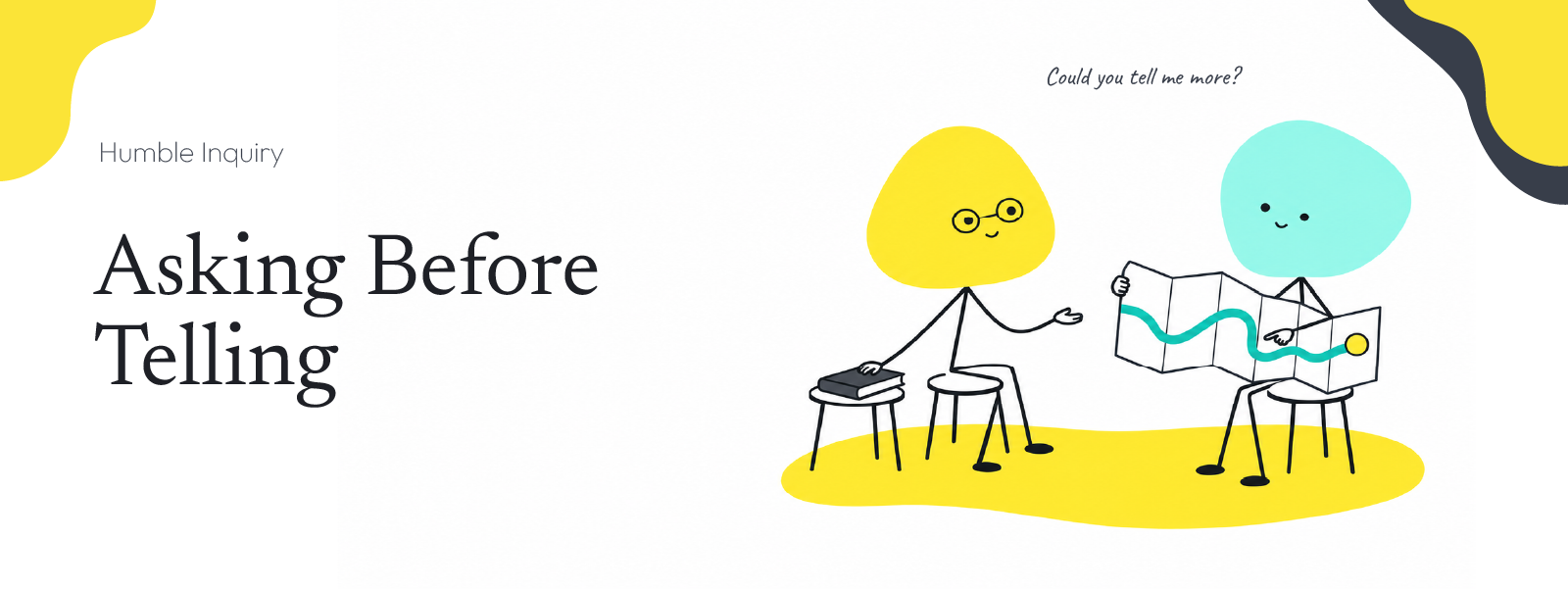
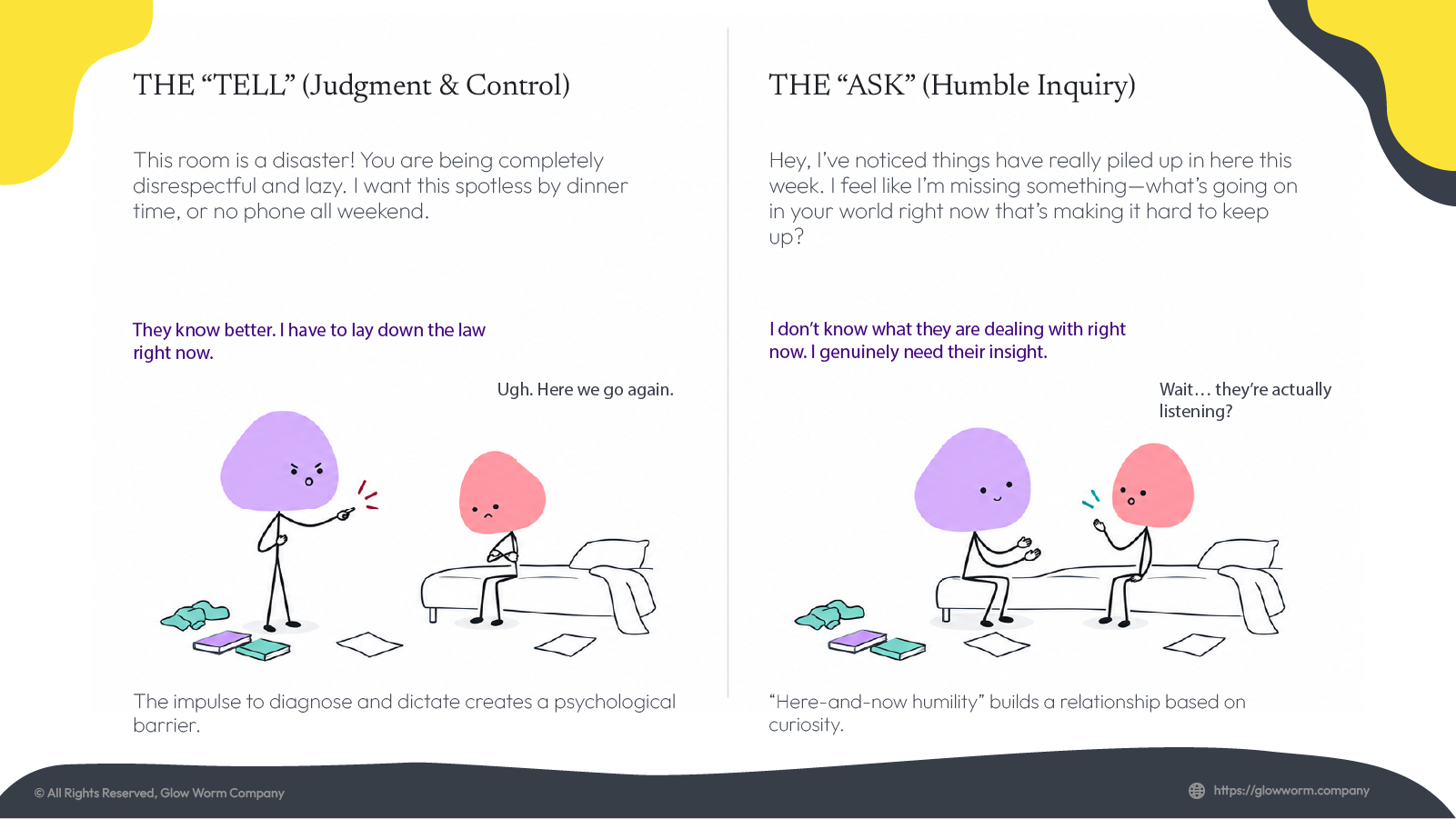
Picture yourself racing against a deadline. Instead of asking, ‘What roadblocks are you hitting?’ your boss launches into a lecture on basic project management. Or imagine cooking a family recipe, instead of asking, ’What’s the secret to this aroma?’ your partner begins reciting the ingredients. In both cases, the opportunity for humble inquiry is lost because the speaker chose to provide answers rather than seek understanding.
In both moments, the impulse to diagnose and dictate, which creates a psychological barrier of diminishment, inspired organizational psychologist Edgar H. Schein to forge the art of Humble Inquiry.
What is Humble Inquiry?
Humble Inquiry is the skill of drawing someone out, of building a relationship based on curiosity and interest in the other person.
Humble Inquiry is the art of asking questions to which you do not already know the answer. It’s a communication method rooted in “here-and-now humility”—the belief that in the current moment, the person you’re speaking with possesses knowledge, experience, or insight that you genuinely need. This brave attitude of mutual dependence actively lights the path to powerfully trusting and cooperative relationships.
Origins of the Concept
Edgar Schein used the term “Humble Inquiry” in his 2009 book ”Helping” inspired from both his personal and professional experiences. Personally, he was struck by how a stranger’s unsolicited warning about poisonous mushrooms left him feeling irritated, because the telling implied his ignorance and destroyed the chance for genuine dialogue.
Professionally, his career in organizational development revealed a pervasive “Culture of Do and Tell,” especially among American leaders who were rewarded for knowing all the answers. This culture proved systemically dangerous in his analysis of the NASA disasters—Challenger in 1986 and Columbia in 2003. In both cases, authority figures failed to ask genuine questions, leading employees to withhold critical, life-saving information out of fear. Humble Inquiry emerged as the necessary countermeasure, proving that genuine curiosity and vulnerability are essential tools for building trust and psychological safety in complex organizations.
What does the research say?
Dr. Amy Edmondson’s foundational work proved that psychological safety is necessary for learning, showing that the risks of asking a “stupid” question or admitting a mistake are actually the vital, brave actions that fuel innovation. Further, Schein’s analysis of NASA disasters confirmed that the true source of catastrophe was not lack of knowledge but the failure of upward communication. Both these works confirmed that fragile safety shatters the moment a leader resorts to “telling” or displaying unquestioned power.
Humble Inquiry compels leaders to adopt “here-and-now humility,” a temporary, generous surrender of authority. By sincerely inviting critical truths, Humble Inquiry transforms the relational DNA from a fear-based climate into the trust-based foundation essential for continuous learning
What makes Humble Inquiry challenging?
Humble Inquiry can be challenging because it defies our ingrained cultural biases toward speed and authority.
It requires a hopeful slowing down and acknowledging what we don’t know, which cuts directly against our conditioning to act as decisive expert individuals. But we often resist this. Remember all those times when… Well, people resist this shift due to four key barriers:
1. Pressure for Speed
We prioritize quick wins and rapid resolutions (in business and in family life). “telling” or advising feels so much faster than the perceived inefficiency of truly asking and listening.
2. The Competence Trap
Inquiry is seen as a sign of weakness or incompetence. Leaders and experts feel they must project certainty. That asking clarifying questions in a work setting, or admitting personal uncertainty to a loved one, means they are failing in their role.
3. Fear of Vulnerability
Asking open questions risks uncovering inconvenient truths (like project failures or unexpected emotional realities) that can complicate the situation or expose the questioner to emotional risk. It feels safer to keep conversations shallow and controlled.
4. “Fix-it” impulse
We often bypass diagnosis by letting our urge to fix contaminate our questions. We rely on pre-conceived notions and judgments instead. This results in immediately proposing remedies, rather than trying to truly understand.
Schein posits that Diagnostic, Confrontational, and Process-Oriented inquiries are inherently risky, as they can steer or provoke defensiveness. Humble Inquiry stands alone as the only form of inquiry rooted in genuine curiosity, demanding that the senior participant acknowledge their dependence on the other’s unique knowledge.. This vital shift deliberately breaks the “Culture of Tell,” moving the team from fear into a learning mindset.
A mental model for practising Humble Inquiry
Let’s say you want to… How do you practice humble inquiry in such a case? The Observation, Reaction, Judgment & Interpretation (ORJI) Cycle is a powerful diagnostic tool for practicing Humble Inquiry which is rooted in self-reflection and the ability to diagnose one’s own behaviour. It’s a rapid, four-stage mental process that reveals exactly where our bias enters a conversation:
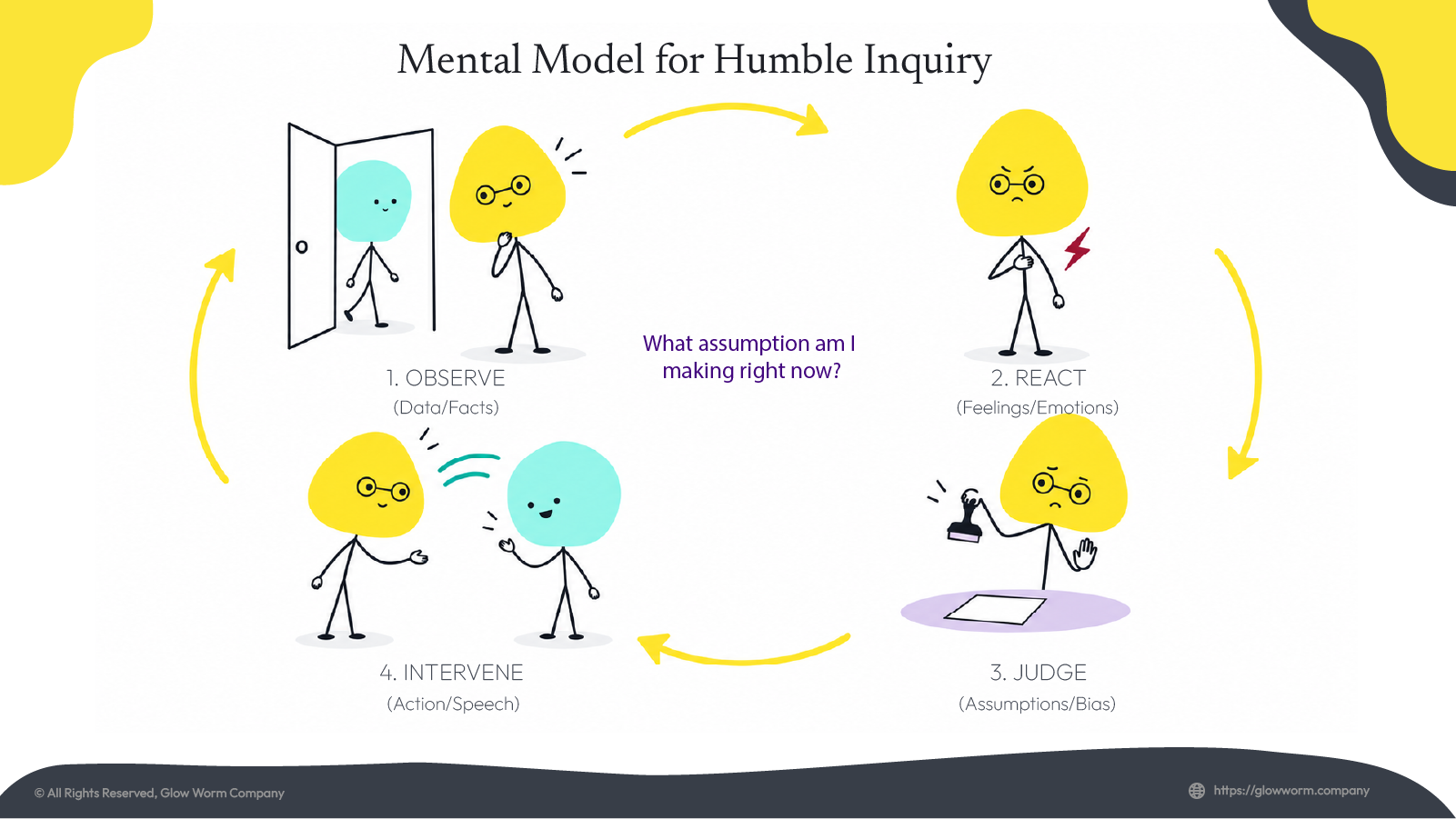
The key to practicing Humble Inquiry lies in interrupting the cycle at the ‘Judge’ stage. By pausing to ask, “What is the judgment I am about to make right now?”, we disarm the impulse to assign blame and instead choose to intervene with an open, non-judgmental Humble Inquiry question. This ensures our response is rooted in genuine curiosity rather than bias and opens up the space for genuine dialogue.
For example, when a colleague arrives late to a meeting, your Observation of their entrance may trigger an immediate Reaction of irritation. This leads to the Judgment that they are being unprofessional. The key to Humble Inquiry is interrupting the cycle at this stage by pausing to ask, “What assumption am I making right now?”. By catching this impulse, you can pivot your Intervention from a sharp critique to a curious question. In this case, it could be that you instead ask, “I noticed you were delayed, is everything alright, or is there a shift in your schedule we should be aware of?”. This pause disarms the impulse to blame and ensures your response is a bridge to understanding rather than a barrier to dialogue.
Applying Humble Inquiry in Practice
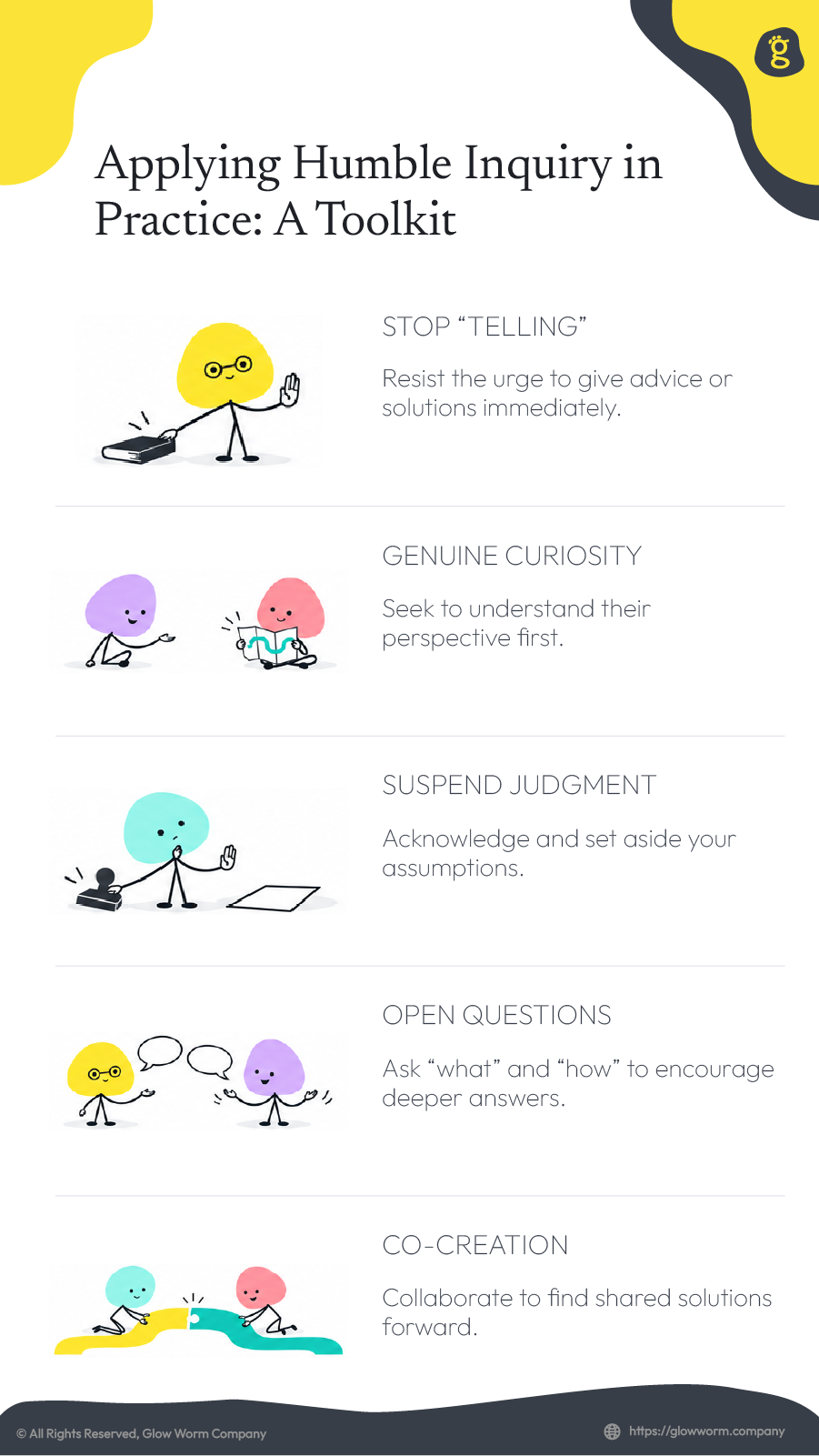
1. Invite Pauses in the conversation
Humble Inquiry requires slowing down the conversation to show respect for the other person and the complexity of the issue. You signal that their input is more important than your schedule or perceived expertise.
Non-Example :“I’m back-to-back with meetings, so just give me the quick version of why we’re behind on this. I don’t have time for the details, I just need to know when it will be done.” (This dismisses the process and uses the boss’s busy schedule as a tool of authority to silence the employee’s perspective.)
Humble Inquiry:“I’ve noticed the timeline has shifted, and while I have a tight schedule, I want to pause and really understand the hurdles you’re facing. I realize I might be missing some key pieces of the puzzle; what have you encountered in this process that I should know about? I’m happy to move my next call if we need more time to walk through this together.”
2. Ask from a Place of Genuine Curiosity
Start the conversation by seeking their perspective rather than imposing a label on the issue. This immediately validates the other person’s experience and encourages them to share freely.
Non-Example :“You’re stressed because you took on too many extracurriculars. Why did you agree to do all that if you didn’t have the time?” (The speaker defines the problem (“too many extracurriculars”) and immediately assigns blame or challenges the person’s judgment, bypassing the need to understand their feelings.)
Humble Inquiry :“Before we discuss solutions, what is your biggest concern right now, and what do you think is contributing to the difficulty?”
3. Suspend making assumptions or judgements
This step requires the most internal discipline. Humility means acknowledging that your assumptions, even when based on actual experience, can be wrong. You must intentionally defer judgment and resist the urge to immediately relate the issue back to your own past experiences.
Non-Example : “This sounds just like the failure we had last year. You need more training on X. Let’s schedule that now.” (The questioner bypasses understanding the current situation by quickly labeling it based on a past event.)
Humble Inquiry Example:“That’s an interesting parallel to something I’ve seen before, but I want to understand your specific context. Could you tell me more?”
4. Ask Open Questions
Use “what” and “how” questions to encourage narrative answers and rich detail, which are essential for true understanding. Asking for specific examples helps move the conversation from abstract complaints to concrete, manageable facts.
Non-Example : Do you agree with the new policy?(This is a closed question that forces a black-or-white answer and stops the dialogue.)
Humble Inquiry : What do you think about the new policy?
5. Co-creating the way forward
The goal is to empower the other person by collaboratively determining the path forward, recognizing that they often own the solution or implementation. This shifts the dynamic from command-and-control to partnership.
Non-Example (Authority-Based): “ The kitchen is a total mess again and I can’t cook in here. You need to make sure everything is put away before you go to bed tonight, otherwise, this just isn’t going to work.” (This uses authority to dictate a solution and focuses on blame rather than the underlying process.)
Humble Inquiry (Co-Creation): “I’ve noticed we’re both struggling to keep the kitchen clear lately, and I realize I might be overlooking how our different schedules are clashing. I want to know, what’s making it hard to keep up with the cleaning lately? Let’s figure out a routine that actually works for both of us.
Summary
More than being a communication technique, Humble Inquiry, is a commitment to see others as essential partners in meeting our goals. By trading the comfort of being right for the courage of being curious, we transform our workplaces and relationships into spaces where everyone’s perspective is valued and every voice has the power to spark innovation.
We cannot co-create the future if we are too busy narrating the present. Let us move away from the ‘Culture of Tell’ and toward a culture of discovery. By pausing to ask, listening to learn, and acting with ‘we’ in mind, let us turn every interaction into an opportunity for shared excellence.