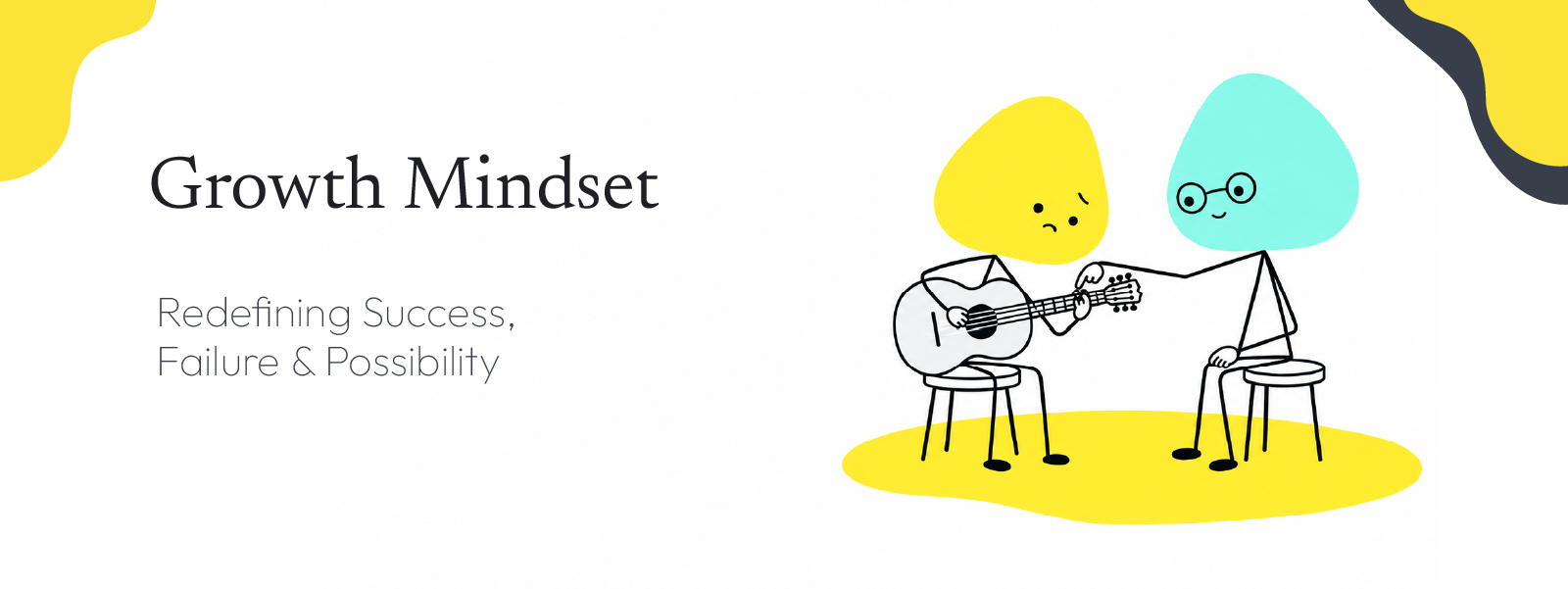
Picture this: you’re learning to play guitar from YouTube tutorials, hitting more off-key notes than sweet ones, and you wonder, “Maybe I’m just not musical.”
Or maybe you’re at work, and a new project rolls in that’s completely unlike anything you’ve handled before. It’s daunting. Your first thought? “I’m just not cut out for this.”
These moments-at work, at home, or anywhere in life-are where your mindset determines what you do next.
Growth Mindset isn’t just a trendy management buzzword. At its core, it’s a way of approaching challenges, learning, and setbacks. Having a Growth Mindset is the belief that your abilities and intelligence aren’t fixed. They’re things you can develop with effort, learning, and persistence.
It’s the vital difference between thinking, “I can’t do this,” and thinking, “I can’t do this… yet.”
Why does this matter? From school exams to job interviews, parenting to picking up a new hobby, the lens through which we see our own potential shapes not only what can be achieved but how we experience setbacks and triumphs along the way.
The Origins
The term ‘Growth Mindset’ was coined by Stanford psychologist Carol Dweck, who spent decades trying to understand how beliefs about intelligence impact learning and achievement. In the 1970s and 1980s, Dweck’s research centered on how children coped with failure—some bounced back stronger, others wilted. The difference wasn’t their raw intelligence, she found, but whether they believed their intelligence was changeable.
Dweck’s pivotal book, “Mindset: The New Psychology of Success,” published in 2006, distilled her findings and brought the concept to the mainstream. She distinguished between two mindsets:
- Fixed Mindset: Believing abilities are carved in stone, leading to avoidance of challenges to protect self-image.
- Growth Mindset: Believing abilities can be cultivated, leading to a hunger for learning and resilience in face of adversity.
Over the years, Dweck and collaborators have refined and tested this model in classrooms, boardrooms, sports teams, and beyond, finding that mindsets can shift, and the effects ripple outward.
How Mindset Shapes Your World
Imagine two friends who decide to try playing pickleball for the first time. They struggle to understand the rules and realize the game needs them to be more athletic than they thought. One friend gets frustrated and vows never to step onto the court again, concluding, “I’m just not a sports person.” The other laughs it off and suggests setting up a weekly practice, thinking, “This is hard, but I bet we can get the hang of it.”
The difference isn’t skill—it’s mindset.
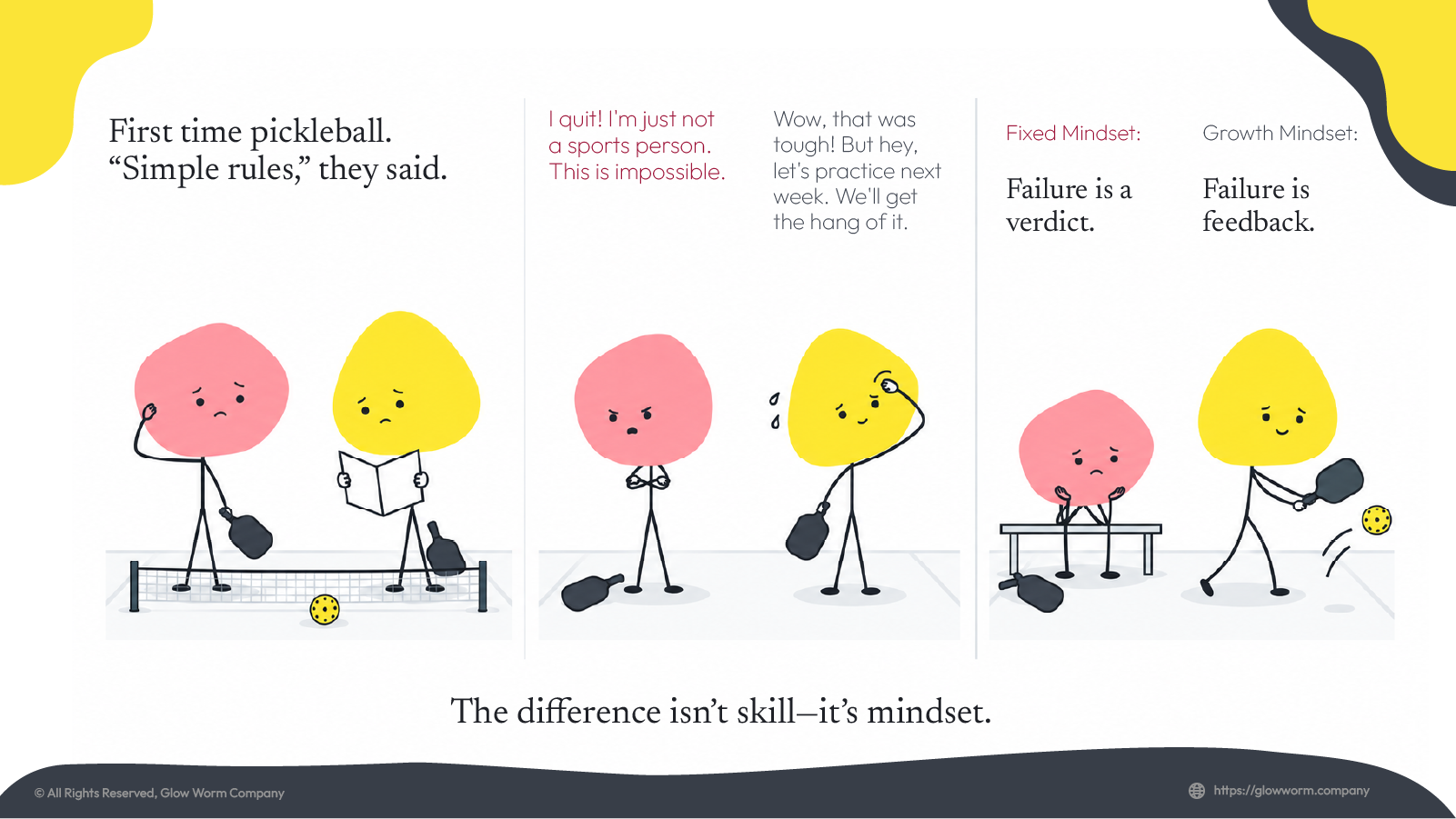
This is where psychology comes in. The friend who quit is operating from what Dweck calls a self-theory of fixed intelligence. They see this failure as a verdict on their permanent ability. The friend who wants to practice is using a growth self-theory—they see the failure as feedback, a temporary data point on a learning curve. They intuitively believe their abilities can be cultivated.
This belief isn’t just wishful thinking; it’s rooted in biology. The concept of neuroplasticity shows that the brain is like a muscle. When you challenge yourself, practice, and learn from mistakes, your brain physically forms new and stronger neural connections.
The moment something feels awkward is the moment your brain is doing its work - awkwardness is a sign of learning, not a sign of incompetence.
When you internalize this, the personal impact is transformative. The framework shifts your entire relationship with challenge and failure, fostering:
- Resilience: You persist despite setbacks because you’re motivated by the process of learning, not just a perfect outcome. A failure isn’t a dead end; it’s a puzzle, something to be solved.
- Curiosity: You start to embrace new experiences, even if you’re awkward at first. Challenges become opportunities to build new neural pathways, not tests to prove your existing worth.
- Self-compassion: You can recognize weaknesses as opportunities to grow instead of as personal shortcomings. This separates your performance from your identity, allowing you to be kind to yourself while you learn.
This shift changes how you behave - you stop protecting your identity and start working on your skills. Difficult feedback at work is no longer an attack (“What’s wrong with me?”) but a guide (“What can I learn?”). A conflict in a personal relationship isn’t just evidence of incompatibility; it’s a chance to practice communication and build a stronger bond.
The Ripple Effects
Growth Mindset isn’t just an individual tool- it’s a social force. This is perhaps most clear in how we raise our children. Dweck’s research found that how we praise them matters immensely.
-
Praising ability (Fixed):“You got an A! You’re so smart!”
-
The hidden message:“If I don’t get an A next time, I’m not smart.” This creates kids who are afraid of challenges.
-
Praising process (Growth):“You got an A! Wow, you used some great study strategies for that test. Tell me how you did it.”
-
The hidden message:“My success is tied to my effort and my strategies, which I can control.” This creates kids who are resilient and love to learn.
When organizations follow Growth Mindset principles, employees participate more and persevere through market changes. Companies that reward experimentation find workers more engaged, innovative, and less risk-averse:
- They treat failure as R&D: Instead of punishing failures, they mine them for data. A failed product launch isn’t a disaster; it’s the price of entry for improvement.
- They destigmatize “I don’t know”: Asking for help is seen as a speed-hack for solving problems, not a confession of weakness.
- They hire for trajectory, not just pedigree: They value “learnability” over a perfect resume, investing in people who adapt rather than just those who already know.
This stands in stark contrast to a fixed-mindset “culture of genius,” where employees are terrified to speak up, hoard information to protect their status, and treat any failure as a personal indictment.
Your 4- Step Growth Mindset Toolkit
Applying a Growth Mindset is about cultivating self-awareness and curiosity. Shifting your mindset is a lifelong practice, not a switch you flip. Here’s a practical, four-step process to start:
Step 1: Hear Your “Fixed” Voice The first step is just to notice. Listen for that internal monologue, especially when you face a challenge:
- “I’m just not a ‘math person.’”
- “This presentation is going to be a disaster. I’m terrible at public speaking.”
- “I’m not creative enough for this.”
Don’t judge the voice. Just acknowledge its presence.
Step 2: Reframe with a “Growth” Voice This is where you actively talk back and make a choice.
- Fixed:“I’m terrible at this.”
- Growth:“I’m learning how to do this. It’s new, so it’s supposed to be hard.”
- Fixed:“I failed.”
- Growth:“That strategy didn’t work. What did I learn from this ‘experiment’?”
Step 3: Use the Power of “Yet” This is the single most powerful tool in the toolkit. Adding “not yet” to your self-talk can transform a verdict into a journey.
- “I don’t understand this… yet.”
- “I can’t do this… yet.”
- “This isn’t working… yet.”
Step 4: Focus on the Process, Not Just the Outcome We often obsess over results. The key to growth is to instead fall in love with the process of learning.
- Set Learning Goals: Instead of a goal like “Get a promotion,” set a process goal like, “I will identify the 3 key skills for the next level and ask for a stretch project that helps me develop one of them.”
- Seek Feedback: Approach feedback as a map for where to grow, not a verdict on your ability or values.
- Reflect Often: When you make a mistake, celebrate it as new data. Ask: “What can this teach me?” and “What will I do differently next time?”
The Fine Print
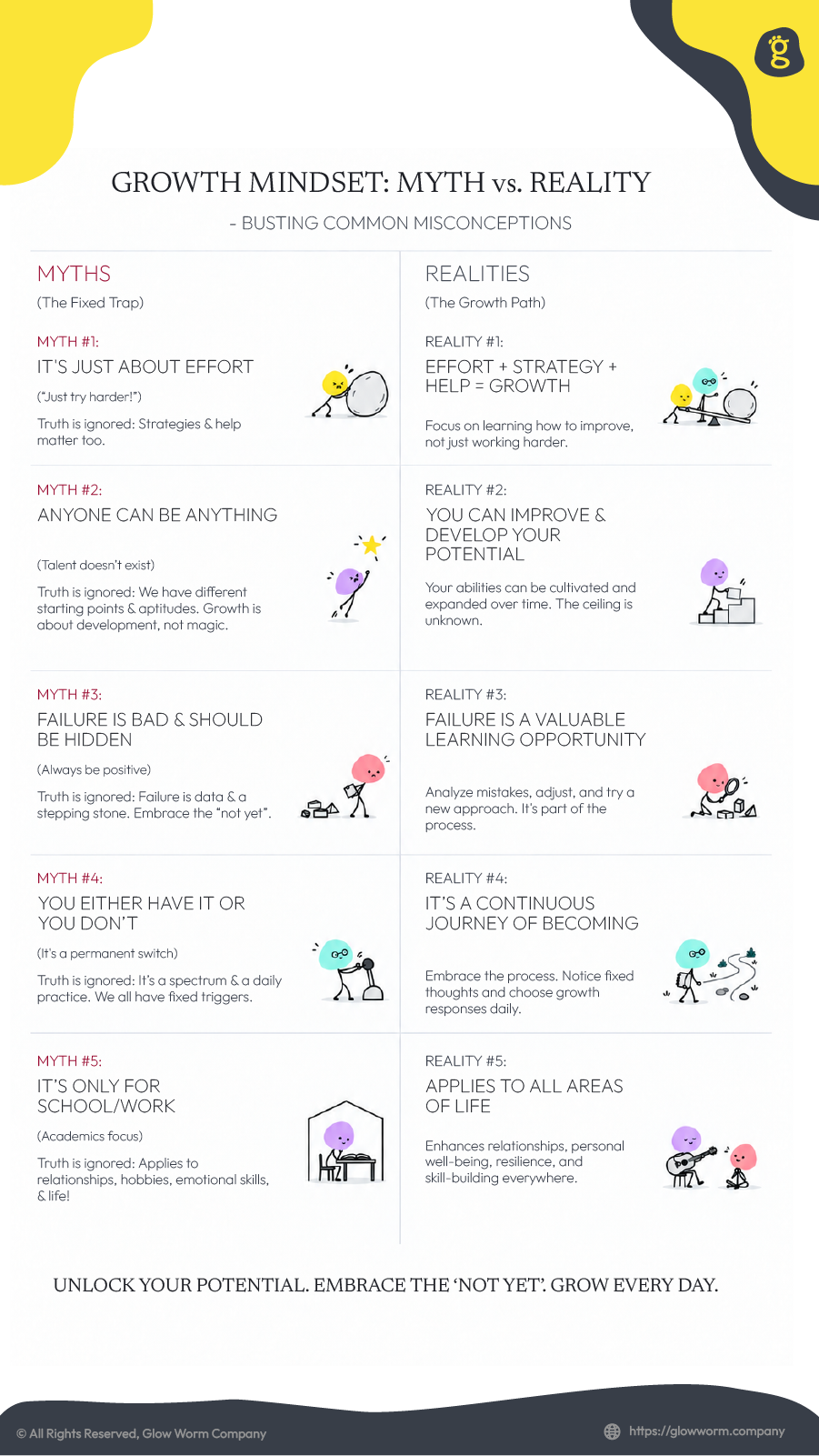
Researchers caution against viewing Growth Mindset as a universal cure-all. For Growth Mindset to actually work you require supportive environments, actionable feedback, and an understanding of systemic issues. It’s one arrow in a larger quiver of strategies for learning and growth. Here are some things to keep in mind:
- Limits of Effort: Sometimes, hard work isn’t enough; resources, support, or systemic barriers play pivotal roles in success. An employee cannot “mindset” their way to hitting a sales quota if the market has crashed or the product is fundamentally broken.
- Avoid Over-Simplification: Telling yourself or others to “try harder” can invalidate real struggles, like disabilities or trauma. When someone is experiencing burnout for example, telling them to have a growth mindset is toxic positivity and unhelpful.
- Balanced Feedback: Praise for effort is useful—if paired with constructive guidance. Empty encouragement can discourage rather than motivate. When sharing feedback for example, saying “Good effort!” on a botched report isn’t helpful. Saying, “I see the effort you put into the research; let’s look at why the conclusion didn’t land,” is helpful.
- Perfection Isn’t the Point: Growth Mindset isn’t about always being optimistic or fearless. It’s about responding to setbacks thoughtfully and recognizing learning as a journey. It’s okay to be frustrated when you lose a client. You don’t have to smile through the struggle to be growing.
Embracing ‘Not Yet’
Growth Mindset invites us to see ourselves and others as works in progress, capable of change, adaptation, and new possibilities. By recognizing that our abilities aren’t carved in stone, we open the door to a more resilient, curious, and fulfilling life.
So, let’s go back to that daunting project at work, or that guitar in the corner. A Fixed Mindset tells you to walk away from the project to protect your reputation, or to leave the guitar to gather dust because you’re “not musical.”
A Growth Mindset gives you permission to fumble. It gives you permission to be a beginner, to hit the off-key notes, and to ask for help on that project. It gives you permission to reflect, learn, and try a different strategy.
So when that next big challenge comes, ask not “Can I do this?” but “How can I learn this?” And remember, that “not yet” is the most powerful part of the entire journey.